

What This Covers
How minimum order quantities are calculated, why multi-SKU brands get trapped by them and how to evaluate whether a supplier’s minimum aligns with your operational runway.
Who This Is For
Brand owners, operations managers and teams sourcing labels for product lines with multiple flavors, scents or seasonal variations.
Core Finding
MOQs are not arbitrary penalties. They are the financial crossover points where a printer’s setup waste and press-time costs meet their target margin.
Bottom Line
An MOQ becomes risky when the volume it demands exceeds what a brand can realistically consume before packaging, regulatory or product changes occur.
This article does not contain affiliate links.
The moment usually happens via email. You need 1,000 labels for a trial batch of a new flavor. The quote comes back needing 5,000.
A label MOQ becomes problematic when the volume it demands exceeds what a brand can realistically consume before future packaging, ingredient, barcode or regulatory changes create inventory risk. For growing consumer brands, the real danger of a high MOQ is never the upfront invoice total. It is the cash locked in dead inventory that gets written off the moment something changes. And when a product line runs multiple SKUs, that risk multiplies fast. SKU fragmentation is what turns a reasonable minimum into an inventory problem.
Suddenly your simple packaging run has become a cash flow calculation. The spreadsheet says your per-unit cost looks better at the higher volume. Your bank account says locking up capital in labels sitting on a warehouse rack is a poor way to scale a brand.
Why label MOQs exist
An MOQ, or minimum order quantity, is the smallest label run a printer will produce for a single job. To understand why they exist, look at the press floor. Minimums are driven by the mechanical realities of the equipment printing your job.
When a press operator sets up a flexographic run, they mount physical polymer plates, mix specific ink formulations and thread hundreds of feet of material through the web to establish color registration. All of this happens before the first usable label comes off the line. This setup waste, both in operator time and physical substrate, carries a fixed cost. The Flexographic Technical Association tracks makeready as one of the industry’s primary efficiency targets for exactly this reason.
Printers are primarily concerned with press utilization time and material waste. The number on your quote is the point where the margin on the finished labels covers the cost of getting the press running. If a printer absorbs setup costs on a job, they cannot economically run an order priced below them.
Why buyers misunderstand label MOQs
Brands often assume the MOQ is an arbitrary barrier. The assumption sounds like this: the printer is forcing me to buy volume I do not need to pad their margins.
The misunderstanding usually comes down to simple division. A buyer sees the price of the full run and assumes a fifth of the quantity should cost a fifth of the money. They assume the machine simply runs for less time.
Printers know the math does not work that way. A supplier running high-speed flexo presses has to demand a high minimum because their equipment is not designed to run short. A digital shop can offer a micro-minimum because their setup involves largely digital workflow preparation rather than physical plate mounting.
When people get this wrong, they try to negotiate the volume down while expecting the same per-unit price. That negotiation has a ceiling. You cannot negotiate past a printer’s setup costs, which is the same reason label quotes and final invoices rarely match.
What a label MOQ actually means in practice
The MOQ on the quote is rarely the full story. The gap between the number on the PDF and what it actually costs a small brand to hit it is where margins get damaged.
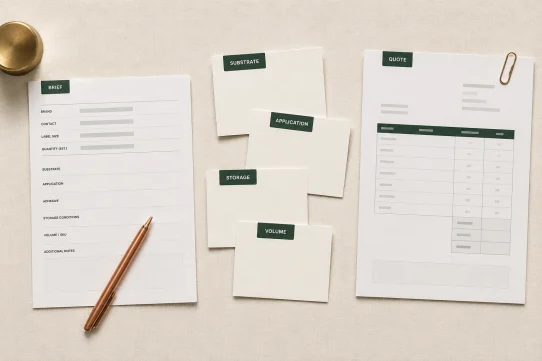
Many growing brands view an MOQ purely as a pricing tier. They look at the unit cost drop and convince themselves the higher volume is a smart investment. This is where the information you provide upfront in a supplier brief becomes decisive. That assumption holds only if the labels will actually be consumed. It assumes the brand will not redesign its packaging, that no nutritional panel change will be mandated and that the flavor will not be discontinued. The math looks clear at the time of ordering. It rarely accounts for what the product line will look like twelve months later.
In many cases, buying a smaller volume at a higher unit cost is the safer operational move. It preserves cash and maintains agility.
SKU fragmentation, the multi-flavor trap
That misunderstanding gets more expensive when the product line runs more than one SKU. This is where most multi-SKU brands miscalculate their purchasing power.
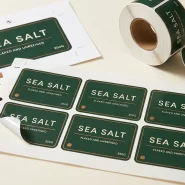
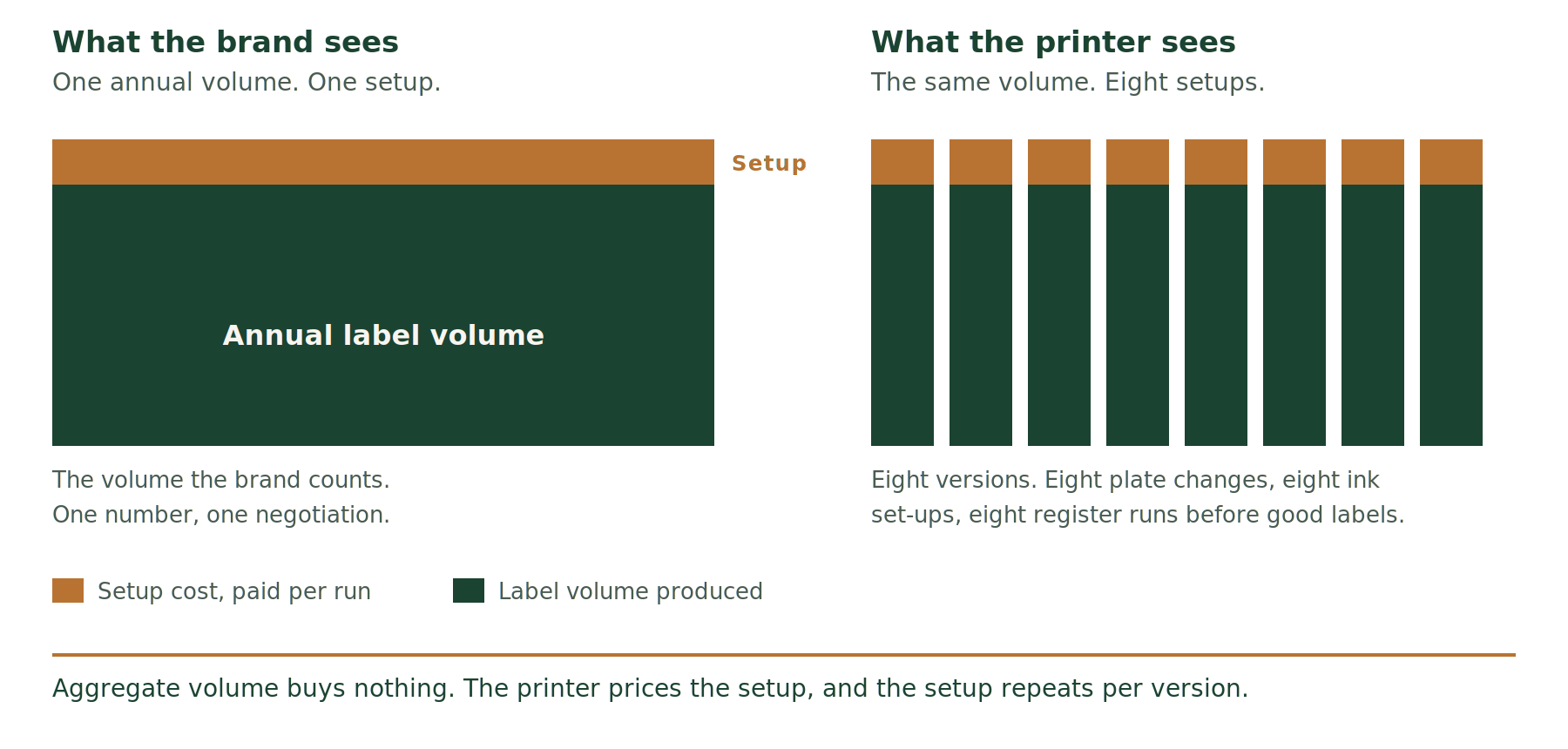
A food or beverage brand looks at their total output and thinks they are a high-volume buyer. But if that volume is split across eight different flavors, they are not. They are buying eight short runs. This is SKU fragmentation, and Figure 1 is what it looks like from the press floor.
Printers evaluate production costs per individual setup. Your aggregate annual volume does not matter to a flexo operator who has to wash down the press and change plates eight separate times. This is one of the core differences between digital and flexo printing economics. If the supplier’s MOQ applies per version, your multi-flavor product line locks you into a large inventory commitment across every variant, regardless of how each specific flavor actually sells.
If your core flavor moves through its labels in a quarter, a standard minimum is manageable. If your seasonal experimental flavor moves a fraction of that, the exact same minimum just saddled you with a multi-year supply of labels.
The question is never whether your total volume is high enough. It is whether your per-SKU volume is high enough. Those are different questions, and most brands ask the first one.
The Bakery Expansion Scenario
The Lesson. The real financial burden of an MOQ is never the initial invoice price of the labels you print. It is the dead capital written off when artwork changes make your remaining inventory obsolete.
The Context. A regional bakery expanded its distribution line from two core products to a multi-flavor line of eight distinct SKUs.
The Misstep. Rather than staying on digital printing, they chased bulk pricing incentives and committed to a flexo supplier’s minimum order per SKU across all eight variants, locking up months of excess inventory across the entire line.
The Friction. Shortly into their distribution expansion, a major retail partner asked for a clean-label ingredient alteration and a nutritional table update across the entire product line.
The Outcome. The bakery was left with large quantities of obsolete labels. The slowest-moving flavor still had four untouched boxes sitting on the rack when the change came through. The per-unit savings from the bulk commitment turned into a cash loss that hit their quarterly distribution margin.
| Production metric | Digital label printing | Flexographic label printing |
|---|---|---|
| Typical MOQ thresholds | Low mechanical minimums. Often bounded only by baseline administrative or file-processing costs. | High structural minimums. Driven by the linear footage needed to clear physical plate setup waste. |
| Material dependencies | Flexible on standard house stocks. Minimums spike only on non-standard specialty substrates. | Highly constrained. Economic viability requires running through large volumes of material per setup. |
| SKU mix capability | Strong for running multi-flavor variants without stopping the press between versions. | Poor for mixed short runs. Each variant requires unique plate changes and localized cleanup. |
The MOQ Reality Check
Before committing to a volume that demands a heavy inventory position, the question is not whether the unit price looks good. The question is whether the operational reality supports carrying that volume. For brands dealing with SKU fragmentation, the inventory liability question is not theoretical. It is the exact situation the bakery scenario illustrates.
Editorial Framework, Living Standard
The MOQ Reality Check
Inventory liability. Will this label volume outlast the planned artwork stability window, or will ingredient adjustments, barcode changes or regulatory updates make them obsolete within the next production cycle?
Cash flow against unit price. Does the lower per-unit cost justify freezing cash in inventory sitting on a shelf, or is that capital more useful in active production or marketing?
Material flexibility. Is the structural minimum driven by a custom stock request? Switching to a standard house material sometimes cuts the minimum substantially.
Storage reality. Does the facility have the climate-controlled capacity to store large label volumes without adhesive degradation or edge-bleed over time?
Before you commit
- Verify house stock statusAsk the account manager whether the chosen substrate is an active house stock or a custom order mill run.
- Calculate the waste factorRequest transparency on how much material is factored into setup waste versus finished product.
- Request combined run policiesCheck whether the printer allows gang-running or combining multiple SKUs of identical dimensions to meet aggregate minimums.
- Confirm reorder frequencyVerify whether the reorder cadence realistically supports consuming that quantity before the next artwork review.
A brand that knows its per-SKU consumption rate walks into the quote conversation with something the printer cannot argue with. A brand that only knows its annual total is negotiating from the wrong number.
Production economics, crossover points and material capabilities vary by supplier, equipment, order quantity and job specifications. Always consult with your packaging supplier before making final procurement decisions.
When is a label MOQ too high for a small brand?
An MOQ becomes too high when the minimum volume forces a brand to hold more inventory than it can realistically consume before the next packaging, ingredient or regulatory change. For growing brands with evolving product lines, that window is often shorter than it looks at the time of ordering.
How does SKU count affect label MOQ economics?
Printers evaluate production costs per individual setup, not by total combined label count. If a brand has ten product flavors and a printer has a minimum per run, the actual structural commitment is that minimum multiplied by ten. If sales are uneven across those flavors, low-volume variants will accumulate dead inventory faster than they move product.
Can label MOQs be negotiated?
Yes, but not past the printer’s setup costs. Rather than asking for a lower number on the same spec, the more effective approach is to negotiate structural levers: switch from a custom material to a standard house stock, or ask whether the printer can combine multiple SKUs of identical dimensions on a single gang run. Understanding how label printers quote the same job at 3x the price is useful context here.
What drives the difference in MOQ between digital and flexo printing?
Flexographic printing needs mechanical setups, physical polymer plates, ink mixing and material waste to establish color registration before the first good label ships. Digital printing bypasses physical plates entirely. Setup waste is minimal, which allows suppliers to offer smaller minimums driven by administrative costs rather than machine economics.
What is the MOQ Reality Check?
The MOQ Reality Check is a four-part operational framework for evaluating whether a supplier’s minimum order represents a smart volume commitment or a liability. It covers inventory obsolescence risk, cash flow strain against unit savings, material flexibility options and storage capacity requirements.