

- What this coversWhy a label quote changes between the first estimate and the final invoice, and which production decisions sit behind the number an estimator sends back.
- Who this is forBrand owners, operations managers and procurement leads requesting label quotes, particularly first and second time buyers.
- Core findingAn estimator prices what is in the email. Everything the email leaves out gets a default, and the defaults are where the number moves.
- Bottom lineThe first number is priced on assumptions about a job nobody has described yet. The invoice is priced on the job you actually have.
A quote request arrives as a sentence. Can you quote 50,000 labels, artwork attached, size in the subject line. A number comes back the same day and it looks reasonable enough that the job moves on the strength of it.
Then the real job arrives. The container is plastic rather than glass, the cartons are going into a freezer, the line is automated and the launch date sits weeks inside standard lead time. The job stops and the number changes.
From where the buyer sits, the supplier moved the price. The estimating desk saw something else, which is that the first number was priced on a job nobody had described yet.
I spent ten years on the production side. The email I sent more than any other was the one explaining that we could not price the job properly, because what we needed to price it was not in front of us.
What an estimator is actually doing
A quote is not one calculation. It is a sequence of production decisions, each one needing an input from the buyer: the facestock that suits the container, the adhesive that holds under the conditions the product will meet, how the job runs on press and how it is finished, wound and packed. Then setup cost, press time, material consumption and where it fits in the schedule.
When an input is missing there are two moves available. Stop and ask, or assume.
Asking can add a day to the response, and a buyer waiting on a number may take the job elsewhere while the question sits in an inbox. Assuming keeps the quote moving and leaves the decision unresolved until more information turns up. Which way a desk goes depends on the supplier, and some come back with questions rather than a price.
Where the desk assumes, what it reaches for is the shop’s usual construction and roll settings. Your job may not be the usual one, and the difference does not surface until somebody mentions the freezer.
What the first quote assumes, and what moves it later
| What the estimator assumes | What moves the number later |
|---|---|
| House stock with a general-purpose permanent adhesive. | Container resin, a wall that flexes or application onto a cold or damp line. |
| Tooling already in the die library and no proof charge. | A size the shop does not hold a die for, a plate charge per color per version or a press proof on the quoted stock. |
| A standard roll build on a 3 inch core, wound the house direction. | A co-packer’s maximum roll diameter, a specific unwind direction or a sensor mark printed on a clear liner. |
| 50,000 labels as one continuous run. | 50,000 split across ten versions of 5,000, which is ten setups rather than one. |
| The quantity ordered is the quantity billed. | An over and under-run tolerance in the terms of sale, applied to the count that actually comes off the press. |
That last row is the one buyers do not see coming, and it sits in the document they already signed. A converter’s terms of sale can carry a quantity tolerance. Where that clause applies the count that comes off the press is the count that ships, and the contract says how far either way still counts as a complete delivery, billed at what was delivered.
Terms differ by supplier. The permitted range can depend on order size, and some converters guarantee an exact count instead. What governs your job is the clause attached to your own order. Read it before you budget on the quantity you asked for.
A job that stopped at proof stage
FROM THE PRODUCTION SIDE
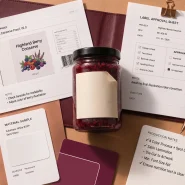
A specialty food brand requested a high-volume quote for jar labels. The request carried artwork, dimensions and quantity. The quote was built on standard gloss paper with a general-purpose permanent adhesive, which is the baseline for ambient jars.
Right before proof sign-off, an offhand comment in an email revealed that the jars were flexible plastic deli containers going into blast-freezer storage. The job halted and requoted.
Three things were wrong with the original specification. The paper construction was not suited to the frost and moisture in that freezer. The flexible container wall moved against a facestock that resisted the curve. And the adhesive was not validated for application to that plastic under the actual line conditions, followed by rapid entry into blast-freezer storage.
The job stopped at proof stage, so none of that was watched happening on a shelf. It is what the specification review found once the real conditions arrived.
The specification was rewritten for a moisture-resistant BOPP facestock with a freezer-grade adhesive. The new quote landed well above the original. The timeline went.
Nothing was wrong with the original communication except four missing words. Plastic container, freezer storage.
Worth being precise about what went wrong there, because the obvious explanation is not the right one. A cured general-purpose acrylic can hold adhesion below zero depending on the grade, and published data sheets put the service range of common grades well under it. That says nothing about whether the same adhesive bonds when it goes onto a cold or damp wall, or whether the bond develops far enough before the pallet enters a blast freezer. Application conditions and service conditions are separate questions, which is the subject of why adhesives fail on refrigerated and frozen products.
A second version of the same gap shows up with automated application. A quote goes out for labels on a curved cosmetic bottle, priced from dimensions and artwork. Weeks later the brand mentions the line is automated.
Moving from hand to a high-speed applicator does not change the facestock or the bottle’s radius, so it is not what makes a stiff label lift off a tight curve. That is a container geometry problem and it was there from the start, covered in why labels peel off bottles at the edges. What the automated line does change is the roll. Liner strength under dispensing tension, core and maximum diameter, unwind direction, whether a clear construction needs a sensor mark. Each of those can affect how the job is specified, produced or priced. None of them were in the brief.
Why the desk quotes fast instead of asking
Suppliers do ask, for the gaps that stop the job outright and when there is time to wait for an answer. A quote desk working across hundreds of product types cannot send a questionnaire back against every request, because a large share of those requests do not become orders and the ones that do are decided on how quickly a number arrives.
Buyers do not help here. A supplier who replies asking for the container resin and the storage temperature is competing against one who replies with a price. The second reply wins the attention even when the first reply is the honest one.
That trade is structural and it is not a fault to fix on the supplier side. It is a condition to work around on the buyer side, by closing the gap before the request goes out rather than after the quote comes back.
What to send before you ask for a number
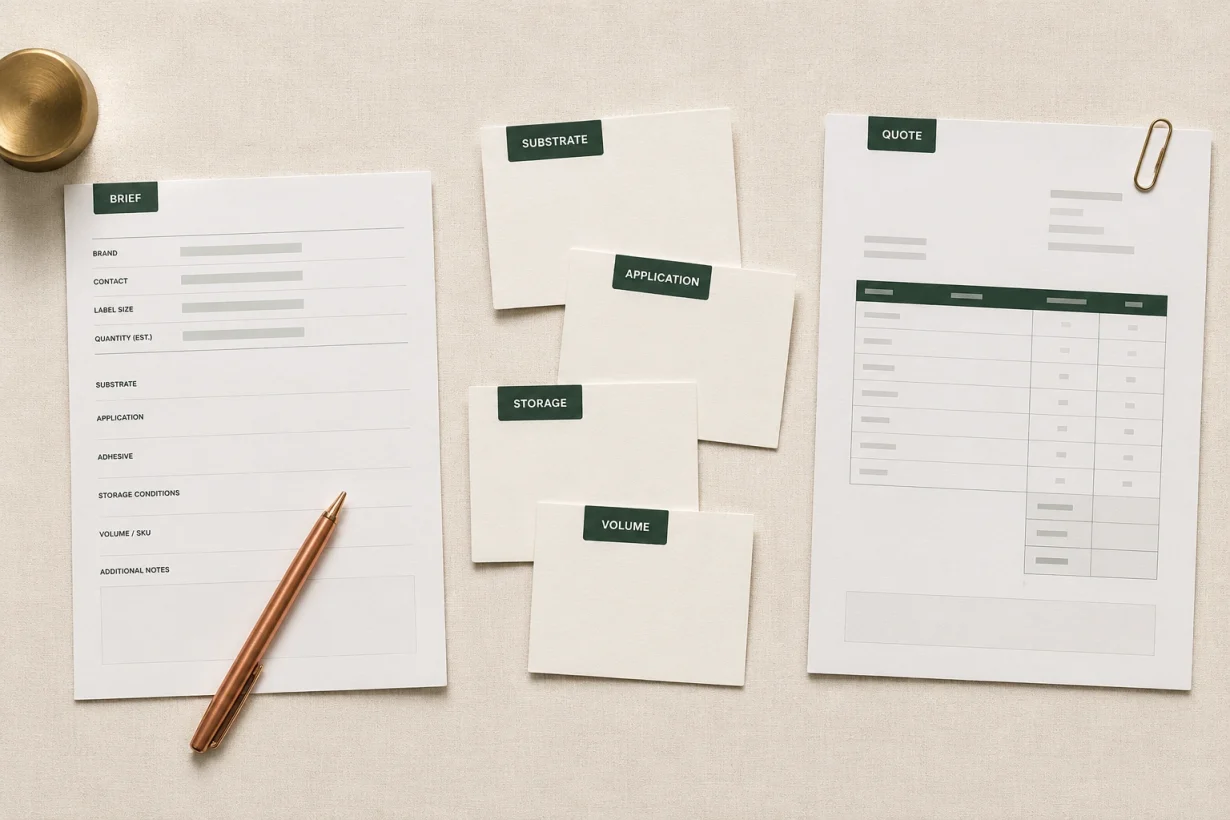
The information an estimator needs is information you already hold. Container and resin, how the label goes on, what the product meets after it is labeled, volume and reorder pattern, finish, timeline and artwork status. None of it needs research. It needs writing down before the request goes out rather than afterwards.
The field-by-field version lives on its own page rather than being repeated here.
Before you request a quote
- What you are solvingGiving the estimator the container, the application, the conditions and the volume pattern so the first number is priced on your job rather than the standard one.
- Read nextWhat a label supplier brief should contain before you request a quote
When two quotes are far apart
- What you are solvingWorking out whether the spread between two printers on one brief comes from equipment, house stock or a different reading of the same request.
- Read nextHow label printers quote the same job at three times the price
And once the labels are made, the same missing information turns into a different problem, which is why labels pass proof approval and still fail in production.
FAQ
Why does my label quote change after the first estimate?
The first estimate is priced on what the request contained, plus a default for everything it did not. As the real specification arrives, container resin, storage temperature, application method, the defaults get replaced and the price moves with them.
Can a printer deliver fewer labels than I ordered and still bill me?
That depends on their terms of sale. Where those carry a quantity tolerance, the invoice follows the quantity delivered rather than the quantity ordered. The permitted range differs by supplier and can depend on order size, and some converters guarantee an exact count instead. Your own terms carry the answer for your job.
What does a label printer need before they can quote accurately?
The container and its resin, how the label is applied, what the product meets after labeling, volume and reorder pattern, finish, timeline and artwork status. The field-by-field version is in the supplier brief guide.
Why do printers quote fast instead of asking questions?
Because a quote desk prices far more jobs than it wins, and the jobs it wins are decided partly on how quickly a number arrives. A reply asking for more information competes against a reply carrying a price, and the price gets read first.
Before you act
Production economics, material capability and quantity tolerances vary by supplier, substrate and equipment. Nothing here describes the terms attached to your own order. Confirm the points on this page against your own supplier and your own contract before committing an order. This article does not contain affiliate links.