


This article does not contain affiliate links.
WHAT THIS COVERS
The hidden production, application and shelf-life trade-offs introduced when switching from standard to sustainable label materials.
WHO THIS IS FOR
Brand owners and packaging managers evaluating a switch to wash-off adhesives, recycled paper facestocks or compostable labels.
CORE FINDING
Sustainable materials are rarely a plug-and-play swap. Upgrading to eco-friendly specs frequently requires slower application speeds, altered press behavior and stricter shelf-life management.
BOTTOM LINE
A label that passes a lab-certified sustainability test can still fail on the packaging line.
Every publication covering the packaging industry eventually lands on the same predictable conclusion. Sustainable label materials are the future. Brands should make the switch. Manufacturer marketing gets summarized. Environmental benefits get listed. Hit publish.
That is not the whole story.
Sustainable label materials are not a like-for-like swap. Every eco-facing decision, whether it is a 100 percent post-consumer waste paper facestock, a wash-off adhesive or a compostable substrate, introduces mechanical trade-offs that most brand owners are not warned about until the failures happen on the production line.
This is not a case against sustainable packaging. It is a reality check. If you are going to switch to sustainable materials, you need to understand what breaks in production when you do, so you can engineer a specification that actually runs on your equipment.
A label engineered to fall apart at the end of its life will not behave the same as a label engineered to survive indefinitely. That single sentence explains most sustainable label failures on the production line.
Why Sustainable Labels Are Not a Like-for-Like Swap
Traditional label materials, standard virgin papers, standard BOPP films and permanent acrylic adhesives, have benefited from decades of relentless optimization. They are engineered for one primary goal. Flawless high-speed performance on the press and on the applicator.
Sustainable materials are engineered for a different primary goal. End-of-life recovery.
When a material is redesigned to release cleanly in an alkaline recycling bath, or to biodegrade in an industrial compost facility, its mechanical properties change. The fiber lengths in the paper are different. The chemical bonds in the adhesive are different. The moisture resistance is different. You cannot take a material engineered to fall apart at end of life and expect it to behave identically to one engineered to last.
This is where most switching decisions go wrong. Brands compare sustainability credentials against sustainability credentials. Suppliers compare sustainability credentials against sustainability credentials. Nobody compares production behavior against production behavior. The gap between what the datasheet promises at end of life and what the label does on the line is where the failures happen.
What Recyclability Actually Means to Recyclers
Before looking at specific production failures, we need to clarify what makes a label sustainable in the eyes of the law and the recycling facility. The definition has changed a lot in the last eighteen months.
With the entry into force of the EU’s Packaging and Packaging Waste Regulation (PPWR) in February 2025, and the harmonization of guidelines between RecyClass in the EU and the Association of Plastic Recyclers (APR) in the US, recyclability is no longer a marketing exercise. It is a strict technical threshold. RecyClass canceled its lower recyclability grades (D, E and F) in April 2025 to align with PPWR’s requirement that packaging achieve a Class A, B or C rating from 2030. APR and RecyClass have also harmonized their density limit for rigid polyolefin packaging at 0.97 g/cm³, which now applies on both sides of the Atlantic. The APR Design Guide is the definitive US authority on how to design packaging for recyclability.
For a US brand exporting to the EU, this changes the calculation. A label spec that satisfies APR alone may still fail RecyClass evaluation if it lands below Class C, which under the current RecyClass methodology is treated as non-recyclable. Hidden Requirements: Why Labels Pass Approval and Still Fail in Production covered how spec gaps can pass approval and still fail in production. Sustainability adds a regulatory layer to the same pattern.
Passing a technical certification also introduces a marketing conflict that most brands only discover after publishing their sustainability copy. The FTC Green Guides in the US require unqualified recyclable claims only when recycling facilities are available to a substantial majority (typically interpreted as 60 percent) of consumers. The 2012 Green Guides remain the operative version. A review opened in December 2022 has not produced a revision as of publication, so the 60 percent threshold applies today. If a brand upgrades to a highly technical, APR-recognized wash-off adhesive that outperforms permanent alternatives on end-of-life recovery, and local US recovery facilities lack the specialized alkaline wash infrastructure to process it, the FTC Green Guides may require a qualified, weaker marketing claim to stay within regulatory bounds.
You pay a premium for a technically superior sustainable label, only to find it legally weakens your marketing copy. That is one of the least discussed and most operationally significant trade-offs in current sustainable packaging.
Trade-off 1: Wash-Off Adhesives and Application Speed
If your brand uses PET bottles, wash-off adhesives are the gold standard for sustainability. To meet APR protocols, these adhesives are tuned through coating weight and monomer composition to release cleanly from rPET when submerged in a hot, alkaline recycling bath.
That tuning has a cost. To achieve a clean release at the end of the bottle’s life, the adhesive’s initial tack is inherently less aggressive than a standard permanent acrylic. Wet-out at the moment of application takes longer. Bond formation takes longer. Everything the labeler asks of the adhesive at the applicator is slower.
The failure pattern looks like this. A brand swaps their standard permanent adhesive for a wash-off construction. The new label passes APR testing in the lab. The datasheet confirms end-of-life performance. When the roll is loaded onto the production line, the labeler cannot run at previous throughput. If the operator attempts to run at the previous line speed, labels fly, fail to separate cleanly from the liner, or fail to wet out on the container. Misalignment appears. Flagged corners appear. First-shift throughput drops.
FINAT’s FTM 3 (low-speed release, 300 mm per minute) and FTM 4 (high-speed release, 1524 mm per minute) test methods document the underlying tension: low release force can cause label fly at conversion and application, and different release-speed behavior between adhesives is a real, measurable variable. Universal speed-loss figures are not published because equipment, substrate and applicator variation makes any single number misleading. What operators consistently see is a meaningful throughput reduction during the initial ramp-up and tuning phase. The direction is reliable. The magnitude is site-specific.
The hidden cost is not the per-thousand price of the adhesive. It is the throughput loss cascading into extended shifts, higher labor cost per unit and delayed order fulfillment during the ramp-up window. None of that appears on the original quote. The Quote Accuracy Gap covered how invoices routinely exceed initial estimates. Sustainable adhesive switches are one of the most consistent sources of that gap.
Trade-off 2: Recycled Paper and Press Behavior
Post-consumer recycled paper facestocks (30 to 100 percent PCW) carry a compelling sustainability claim. They also carry structural differences from virgin paper that most brand owners are never briefed on.
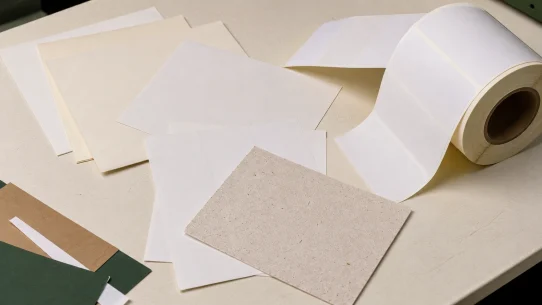
Recycled paper has shorter average fiber lengths than virgin paper because each recycling cycle mechanically shortens the fibers. It typically has higher filler content to compensate for the strength loss. Its moisture pickup during printing differs from virgin paper. Its dimensional stability under tension is lower. Its die-cutting tolerance is narrower. Each of these is small in isolation. Together they add up to a facestock that behaves noticeably differently on the same press.
The failure pattern is subtle. A brand switches from standard virgin paper to a 100 percent PCW paper to strengthen its sustainability claim. Print quality drops on the same press with the same operator. Registration issues appear on multi-color runs. Linting increases, requiring more frequent press cleaning. Die-cut waste increases. Some of these costs are absorbed by the converter. Some are passed through as a higher unit price. The brand ends up paying more per label for a material that performs worse in production, and the reasons are buried in technical bulletins the brand never sees.
Avery Dennison and other major facestock manufacturers publish recycled paper technical documentation that acknowledges these considerations. The documentation exists. It is just not front and center. The gap between the marketing surface (100 percent PCW) and the technical detail (fiber length, filler content, converting behavior) is where brand owners get caught.
The switch to recycled paper is often the right decision. But it needs to be made with the converter in the room, not by the marketing department alone. A proper supplier brief covered what a brief should contain. For sustainable substrates, that brief needs a converting-performance section that most briefs currently skip.
Trade-off 3: Compostable Adhesives and Shelf Life
Compostable adhesives are certified against ASTM D6400 by the Biodegradable Products Institute (BPI). The certification protocol requires the material to achieve at least 90 percent biodegradation within 180 days and physical disintegration within 84 days under industrial composting conditions. Well-run commercial facilities often process compostable packaging in 60 to 90 days in practice, but that reflects operational performance, not the standard’s requirement.
Certified compostable adhesives are formulated to remain stable during normal shelf life and to activate their breakdown behavior only under the elevated heat, moisture and microbial activity of an industrial compost facility. Real-world performance can drift from that ideal. Products with very long shelf life, warm-climate distribution exposure or high UV load may show adhesive migration, edge lift or bond softening earlier than the datasheet suggests. This is not a failure of the certification. It is the gap between certification conditions and edge-case distribution reality.
The failure pattern shows up as adhesive migration at label edges, tired shelf appearance and, in extreme cases, label detachment from units that never reached the consumer. The compostable claim remains technically valid. The product’s shelf presence is what suffers. Retailer feedback usually arrives through account management before it reaches consumer complaints.
Certification bodies test end-of-life composting. They do not routinely publish accelerated aging data under extreme distribution conditions. For any product with a shelf life beyond twelve months, or any product with warm-climate distribution exposure, compostable adhesives need supplementary shelf-life testing before commitment. That testing is usually not offered without a specific request.
For refillable or reusable formats with fast turnover, compostable adhesives are often the right choice. For long-shelf-life SKUs in traditional distribution, they introduce a shelf-appearance risk that outweighs the sustainability claim’s marketing value.
The Sustainability Trade-off Test
Before signing off on a sustainable label spec, walk through three questions. If your supplier cannot answer all three with confidence, the specification is not ready to order.
THE SUSTAINABILITY TRADE-OFF TEST
☐ Recycling Stream Match. What specific recycling stream will the packaging enter (PET, HDPE, PP, paper, industrial compost) and has this exact label construction been tested against that stream’s protocol (APR, RecyClass, BPI)? The answer must reference a specific protocol, not a general recyclability claim. If the answer is vague, the label may fail the stream it is marketed for.
☐ Converting Compatibility. Has this sustainable material been run at your target application speed on your labeler, with your current dies, at your typical dispensing temperature? The answer must reference converter test data, not manufacturer spec sheets. If the answer is no, expect a line speed reduction during initial ramp-up. Budget the shift extensions before you commit.
☐ Shelf-Life Behavior. How does this adhesive and facestock combination perform after 6, 12 and 18 months of normal shelf conditions (typical retail temperature range, humidity, ambient light)? The answer must reference accelerated aging data or extended real-world testing. If none exists, treat the switch as a shelf-life experiment, not a validated spec change.
Missing any one of these three answers means the sustainable label specification is incomplete, even if the material is described as certified. Ask for the answers in writing, not verbally.
A Craft Beverage Wash-Off Switch
THE CRAFT BEVERAGE WASH-OFF SWITCH
The Lesson: A wash-off adhesive that passes lab certification may still cost you a production line if application speed is not tested on your specific equipment before the order is placed.
The Context: During one bottle reuse pilot we observed, a craft beverage brand serving 12 SKUs shifted to a wash-off adhesive construction to support a regional distributor’s returnable bottle program. The APR-recognized wash-off adhesive was recommended by the label supplier as the efficient path to the sustainability claim the pilot required.
The Misstep: The supplier’s recommendation was based on APR compliance and cost per thousand. Application speed on the brand’s existing labeler was not tested before the order was placed. Nobody in the sales conversation asked whether the brand’s labeler ran at a speed compatible with the wash-off adhesive’s dwell-time requirement.
The Friction: First production run struggled to hit the labeler’s previous throughput. The wash-off adhesive required longer dwell time to form initial bond. Extended dispensing caused label misalignment on a portion of the run. Second-shift labor was added to hit the launch date. Per-unit cost through the ramp-up period increased notably above quote.
The Outcome: The brand paused the reuse pilot to re-engineer the label construction. A revised spec paired the wash-off adhesive with a stiffer facestock optimized for high-speed dispensing. Application speed recovered close to previous throughput after tuning. The reuse pilot restarted three months later. Total delay: 90 days. Total cost of the mistake: considerably higher than the per-thousand price difference between the wash-off and the previous permanent construction. The pilot was successful eventually. The bruise was avoidable.
Sustainable Label Material Types
Three material families dominate the sustainable label conversation. Each family solves a different end-of-life problem and each carries a different production trade-off. This is similar to the material and method selection covered in Digital vs Flexo Label Printing.
SUSTAINABLE LABEL MATERIAL FAMILIES
| Family | Trade-off Summary | Typical Mistake |
|---|---|---|
| Wash-Off PET beverage |
Enables closed-loop PET bottle recycling under APR protocol. Trade-off: measurable application speed reduction during ramp-up. | Specified against APR compliance alone, without testing application speed on the actual labeler. |
| Recycled Paper 30 to 100% PCW |
Reduces virgin fiber demand, supports FSC and SFI credentials. Trade-off: linting, registration variance, narrower die-cut tolerance on the same press. | Switched from virgin paper without a converting compatibility check, resulting in higher per-unit cost and lower print quality. |
| Compostable BPI certified |
End-of-life composting for refillable and short-shelf-life formats. Trade-off: potential adhesive drift under extreme shelf conditions. | Applied to long-shelf-life SKUs distributed through warm-climate warehouses, causing adhesive migration and tired shelf appearance. |
Questions to Ask Your Supplier Before You Order
PRE-ORDER SUPPLIER CHECKLIST
☐ Ask which recycling stream this exact construction has been tested against. Not the material’s general credentials. This specific facestock, this specific adhesive, this specific liner, tested against APR, RecyClass or BPI protocol. Ask for the test result or approval letter.
☐ Ask for converter test data at your target application speed. If the supplier cannot produce converter test data at the speed your labeler runs, treat the initial production run as the test. Budget accordingly.
☐ Ask about shelf-life behavior under extreme storage conditions. Especially for compostable constructions and any adhesive marketed as biodegradable. If no accelerated aging data exists, ask what the supplier’s recommendation is for products with shelf life beyond twelve months or with warm-climate distribution.
☐ Ask how the material behaves against your target regulatory regime. For US brands exporting to the EU, ask whether the construction meets RecyClass Class A, B or C under the current harmonized methodology. For US-only distribution, ask how the FTC Green Guides claim structure changes if this material is used. This is not legal advice, but the answer will shape your marketing copy.
☐ Ask what the supplier does not recommend this material for. If the answer is nothing, the supplier has not thought carefully enough about the trade-off. A material that works everywhere works nowhere in particular. A supplier who names a limitation is a supplier who understands the material.
Sustainable label materials are worth the switch when the trade-offs are understood in advance. They cost more than expected when the switch is made without the questions above being answered.
A sustainability certification tells you what the material does at end of life. It tells you nothing about what the material does on your production line, at your application speed, over your shelf life. Both answers matter. Only one is on the datasheet.
Sustainable label materials, cold chain performance, adhesive behavior and substrate compatibility vary by manufacturer, formulation, application conditions and regulatory regime. Confirm all specifications with your label supplier, adhesive manufacturer and legal counsel where marketing claims are involved before finalizing production. This article describes patterns observed across sustainable label production and is not a substitute for supplier-specific technical data or regulatory advice.
FAQ
Are sustainable label materials always more expensive than standard materials?
Not by per-thousand price alone. Sustainable materials often cost more per thousand, but the true cost gap widens or narrows based on production ramp-up costs, throughput loss and rework. A material that costs 15 percent more per thousand and slows the line during the first eight weeks can double the initial project cost. A material that costs 30 percent more per thousand with no production impact may be cheaper over a full year. Compare total delivered cost, not per-thousand quote.
Can I claim my product is recyclable in the US if I use a wash-off adhesive?
Depends on where the product is distributed. The FTC Green Guides require unqualified recyclable claims only when recycling facilities are available to a substantial majority of consumers. The 2012 Guides remain in force, with 60 percent as the operative threshold. Wash-off adhesive infrastructure varies by region. Confirm claim structure with your legal counsel and consider a qualified claim (such as recyclable where facilities exist) if coverage is uneven.
What is the difference between APR and RecyClass?
APR is the US Association of Plastic Recyclers. RecyClass is the equivalent EU certification body. Both publish design guidelines for recyclability. They have harmonized several standards including a 0.97 g/cm³ density limit for rigid polyolefin packaging, but their testing protocols and certifications remain separate. A material certified under APR is not automatically compliant with RecyClass, and vice versa. For brands exporting to both markets, verify against both.
How much does switching to a sustainable adhesive slow down a production line?
For wash-off adhesives on PET containers, expect a meaningful application speed reduction during the initial ramp-up and tuning phase. Exact figures vary by labeler design, facestock stiffness and applicator settings, so no single industry benchmark applies. Test on your specific equipment before committing to launch dates.
Are compostable labels appropriate for all product categories?
Not without careful selection. Certified compostable adhesives are engineered to remain stable during normal shelf life and activate their breakdown behavior only in industrial composting conditions. For products with shelf life beyond twelve months, or products distributed through warm-climate warehouses, compostable adhesives can show earlier bond degradation than expected. They work best for refillable, reusable or short-shelf-life formats where turnover is rapid.
What is the most common mistake brands make when switching to sustainable label materials?
Comparing certifications against certifications and treating the switch as plug-and-play. Sustainable materials solve an end-of-life problem. They introduce a production problem that has to be solved separately. Brands who succeed treat the switch as a specification change requiring converter involvement, application testing and shelf-life validation. Brands who struggle treat it as a purchasing decision based on datasheet claims.