

Quick summary
What This Covers. Why the price of a label job does not scale with quantity as simply as most buyers expect, and what actually moves the number.
Who This Is For. Small business owners requesting label quotes for the first few times, trying to work out whether a price is reasonable.
Core Finding. You are looking at a finished label. The printer is looking at a manufacturing process. Most of what decides your price happens between those two views.
Bottom Line. You cannot calculate what labels should cost. You can specify the job so the quote you get back is useful.
The calculation everyone tries
It goes something like this. My label is this size. I need this many. Material costs roughly this much per square foot. So the price should be about here.
Then three quotes come back, none of them match the calculation, and none of them match each other.
The arithmetic is not wrong. It is answering a different question. It works out what the material would cost if you were pricing the material by the square foot. What you are actually buying is a manufacturing run that produces finished labels, and some of that work has to happen whether you order five hundred or five thousand.
Why quantity is an incomplete answer
Almost every guide to label printing price is organised by volume. Under this many, use one process. Over this many, switch to another. Order more and the unit price drops.
None of that is wrong exactly. Unit price does fall with quantity, and the production method does change as volume grows. But a table of thresholds suggests the relationship is simple and predictable, and it is neither.
Two jobs at the same quantity can price very differently. Two jobs at different quantities can land closer together than you would expect. Quantity is one input among several, and it does not determine the price on its own.
What the printer sees that you do not
Here is the part that makes this difficult. Two labels of almost identical area can behave very differently in production, and nothing about the finished label tells you which one you specified.
You are holding an object. The quote was built from a process, and most of that process is invisible once the labels are made.
Much of the setup happens once, regardless of run length. Before a single label is printed, the job has to be prepared. Depending on the process that can mean physical plates, one for each color. It means a cutting tool matched to your shape and size. It means the press being set, run up to color and checked. Those costs land whether the run is short or long, so on a short order they can make up a much larger share of what you are paying for. On a long one they spread across more labels, which is why unit prices fall with volume.
Your size decides how efficiently the material runs. Labels are produced from a roll of material of a fixed width. Your dimensions determine how many fit across that width and how they step along it. A size that fits neatly uses most of the material. A size that does not leaves waste around every label, and that waste is bought, run and discarded. It is in your price whether or not anyone mentions it.
Colors are not only a design decision. Depending on the printing process, additional colors can introduce additional setup, plates or press requirements. A design using fewer colors is not just simpler to look at, it can be a shorter and cheaper job to prepare.
Finishing is a separate operation. Lamination, varnish, foil and anything applied after printing is another pass with its own setup and its own material. It is easy to treat a finish as a styling choice made at the design stage. It is a production step with a cost attached.
And the shop is a business, not a machine. Two companies with comparable equipment can quote the same job differently because they are different businesses with different overheads, different customer bases and different views on whether your job suits them. That is covered in more depth in how label printers quote the same job at 3x the price.
The order that looked expensive and was not
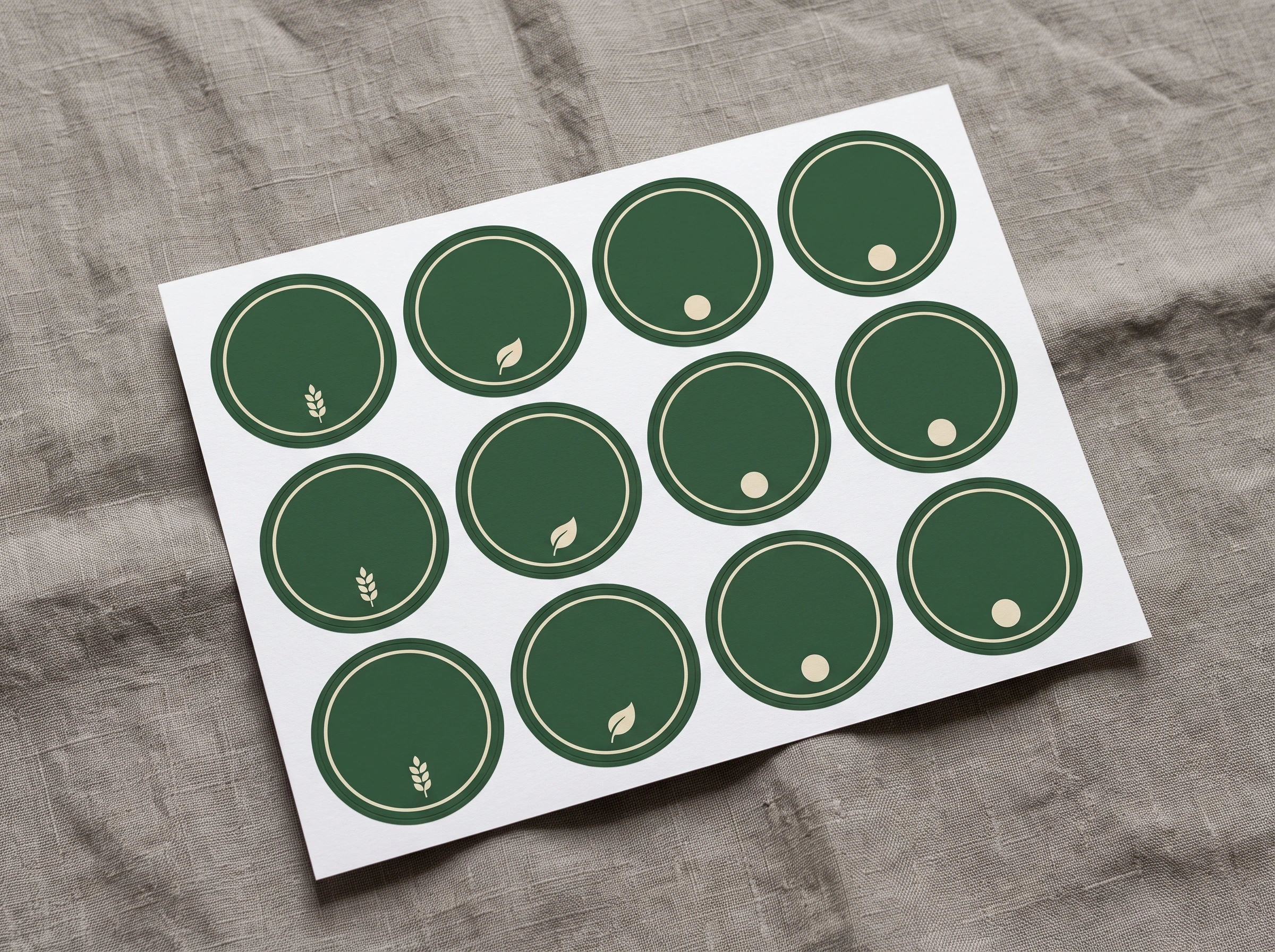
A bakery customer came to us with 17 cookie products, each with its own label. The quantities were nothing alike. Established lines needed one to three thousand labels each. New products needed a hundred or five hundred, because she did not yet know how they would sell. Around twenty thousand labels in total, split 17 ways.
Her question was whether the mixed quantities would push the price up. It is the right question, and the answer was not what she expected.
She had ordered rolls before. These labels were being applied by hand, so rolls were not doing anything for her. We suggested digital printing on sheets instead, and did the prepress and the placement on the sheets ourselves.
The detail that made it work was one she had not thought about. All 17 designs were the same two inch circle on the same material, so the artwork was the only thing that changed between them.
She said the price was better than she expected before she placed the order.
That order was messy from where she sat and compact from where we did. Seventeen products, seventeen quantities, seventeen designs on her side. One format, one material and one production configuration on ours. Even the prepress was lighter than it sounds, because once the layout exists the designs drop into it.
Nothing about any one of those finished labels would have told her that.
Why more is not automatically cheaper
The unit price falls as quantity rises. That much is reliable, and it is why buyers are often encouraged upward at the quoting stage.
What the unit price does not account for is everything that happens to labels you have not used yet. Artwork changes. Ingredients change. A regulation changes what has to appear on the pack. Whatever is left in the box at that point was bought at a lower unit price and may become unusable.
The saving is real. It is calculated against a quantity you might not get through, and only you know how stable your product actually is.
What you can control
You cannot work out what a job should cost. You can change what you are asking for, so the quotes come back sensible and comparable.
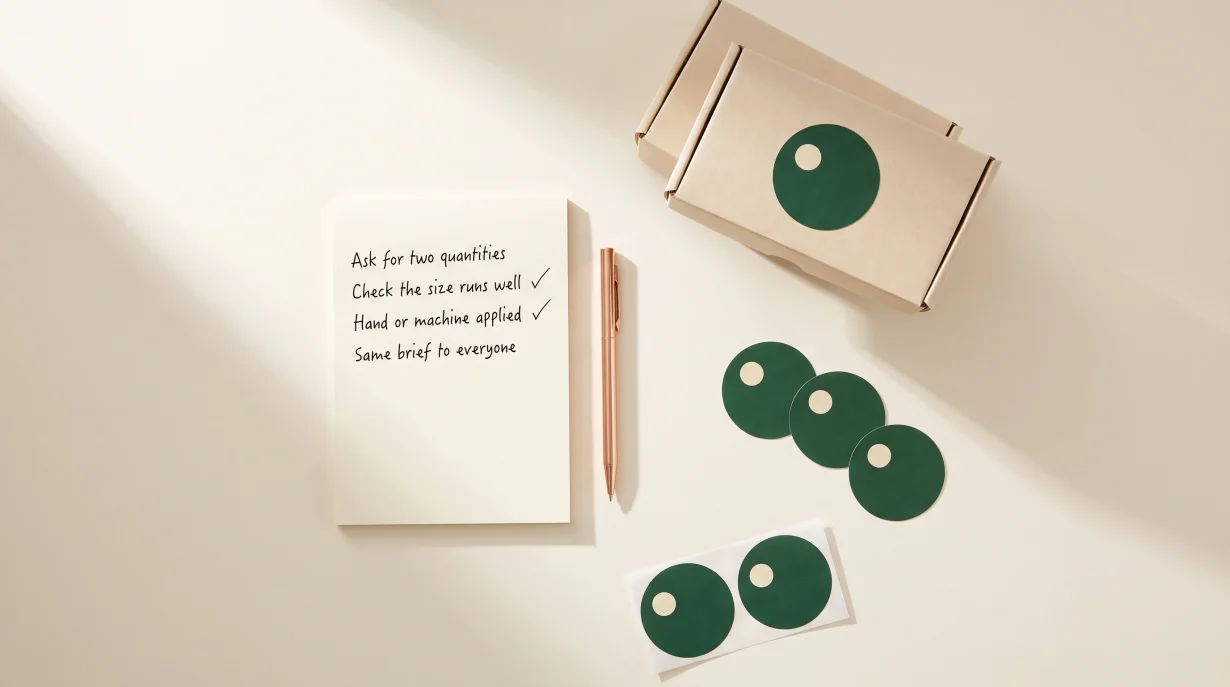
Ask for more than one quantity. Requesting a price at two or three quantities shows you where the curve bends for that supplier rather than leaving you with a single number and no context. It also tells you something about how their setup costs are structured.
Ask whether your size is efficient. A printer can tell you whether your dimensions run well on their material, and whether a small adjustment would help. If you do not ask, the question never comes up and the waste stays in the price.
Ask how the labels will be applied. By hand or by machine changes what format makes sense, and format changes the job. The bakery order above was cheaper on sheets than on rolls for exactly this reason, and nobody would have known to ask if it had not come up.
Keep sizes and materials consistent across your range. If you have several products or variants, designing them to the same size and the same material means they can often be produced together rather than as separate jobs. This is a decision made once at the design stage that pays on every order afterward.
Ask whether designs can run together. If you do have several designs at the same size, ask whether they can run as one job rather than several. Raising that question at the quoting stage gives the printer an opportunity to price the work differently.
Give every supplier the same brief. Three quotes are only comparable if all three received the same information, which is covered in what a label supplier brief should contain. Different briefs produce different assumptions, and the price gap you are looking at may be a gap in what each shop thought you wanted. It is the same reason the questions you ask before ordering matter.
Where this leaves you
Before you compare quotes
- Ask for pricing at two or three quantities, not one, so you can see how the supplier’s price changes with volume
- Ask whether your label size runs efficiently on their material
- Tell them how the labels will be applied, by hand or by machine
- Ask whether a small size adjustment would change the price
- Keep sizes and materials consistent across your product range
- Ask whether multiple designs can run as one job
- Send every supplier the same brief
A quote is not a calculation you can reconstruct from the finished label alone. It is a manufacturer telling you what it costs them to make your specification, on their equipment, in their shop, this month.
What you can do is make sure they all received the same question.
Production economics, crossover points and material capabilities vary by supplier, equipment, order quantity and job specifications. Always consult with your packaging supplier before making final procurement decisions.
FAQ
How much does a label cost?
There is no single standard price. Cost depends on quantity, size, material, number of colors, production method and finishing. Some setup costs are incurred regardless of run length, so they represent a much larger share of a small order. The useful step is to request pricing at more than one quantity so you can see how the cost behaves.
Why is the label printing price per label higher for a small order?
Preparing a job involves work that happens once, whatever the run length. Depending on the process, plates, cutting tools and press setup are examples. On a small order those costs are divided across fewer labels, so each one carries more of them.
Does ordering more labels always save money?
The unit price falls, but the saving only holds if you use the labels. Artwork changes, ingredient changes and regulatory changes can leave unused stock unusable, so the calculation depends on how stable your product is.
Does the shape of my label affect the price?
It can. Labels are produced from material of a fixed width, and the dimensions determine how efficiently they fit across it. A size that leaves significant waste around each label carries the cost of that waste, so it is worth asking your printer whether your size runs efficiently.
Why did three printers quote such different prices for the same job?
Different equipment, different overheads and different views on whether the job suits them all affect the number. Differences in the brief each supplier received also matter, which is why sending all three the same information is the only way to make quotes comparable.