

This article does not contain affiliate links.
WHAT THIS COVERS
How to select a cold chain label adhesive that survives the actual conditions your product will experience, not the single temperature written on the datasheet.
WHO THIS IS FOR
Brand owners with frozen, refrigerated or freeze-thaw products who have had labels lift, wrinkle or fall off after distribution. Also brand owners specifying cold chain labels for the first time.
CORE FINDING
A freezer-rated adhesive is not one specification. It is three separate performance requirements that most brands, and some suppliers, treat as one.
BOTTOM LINE
Most cold chain label failures come from adhesive selection based on storage temperature alone. Application temperature is where the real damage starts.
The label was rated for freezer storage. The datasheet said cold-rated. The supplier approved the material. Two weeks after the first production run, the retailer called to say labels were coming off in the freezer aisle.
Cold chain label failures rarely happen at the temperature the adhesive was rated for. They happen at the moment of application, during transit temperature swings, or after freeze-thaw cycling that the datasheet never mentioned. A freezer-rated or cold-storage adhesive is not one specification. It is three separate performance requirements that most brands, and some suppliers, treat as one.
In our experience, this is one of the more common reasons cold chain labels fail in the field. Not the wrong adhesive family. The right adhesive family selected against the wrong single temperature.
A cold-storage rating tells you what happens after the label is bonded. It tells you nothing about whether the label was ever bonded correctly in the first place.
Why “Freezer-Rated” Is Not a Complete Spec
When a supplier says an adhesive is freezer-rated, they usually mean one thing. The adhesive maintains bond strength at the storage temperature listed on the datasheet. Common ratings look like minus 20 degrees Celsius or minus 40 degrees Fahrenheit for a deep-freeze grade.
What that number does not tell you. Whether the adhesive can be applied at low temperatures. Whether the adhesive tolerates repeated freeze-thaw cycles. Whether the adhesive maintains initial tack after warming above the storage rating and returning below it. Whether the substrate the label is applied to has enough surface energy at cold temperatures for the adhesive to wet out.
Each of those is a separate performance question. The datasheet answers one of them. Real cold chain distribution asks all four.
Most brands negotiate an adhesive selection based on where the product will be stored. The retailer said frozen aisle. The brand said we need freezer-rated. The conversation ended there. That is the same specification-gap pattern covered in Hidden Requirements: Why Labels Pass Approval and Still Fail in Production, applied to adhesive chemistry.
What Actually Happens to Adhesive in Cold Conditions
Pressure-sensitive adhesive is a chemistry problem, not a mechanical one. The adhesive works by flowing microscopically into the surface texture of the substrate. When the label is pressed onto the container, the adhesive fills the tiny valleys in the surface. That flow, called wet-out, creates the bond.
Wet-out is temperature-dependent. Adhesive at room temperature flows readily. Adhesive at zero degrees Celsius flows sluggishly. Adhesive at minus 20 degrees Celsius barely flows at all. If the adhesive cannot wet out at application, it never forms a complete bond. It sits on the surface and waits to fail.
This is why the first failure mode of cold chain labels is usually not adhesion loss at storage temperature. It is incomplete bond formation at application. The label looks fine when it leaves the packaging line. Then transit vibration, minor thermal cycling or shelf handling breaks the incomplete bond. The label lifts, curls at the edges or peels.
Storage temperature performance only becomes the failure mode if the adhesive was correctly bonded to begin with. Most cold chain failures never reach storage-temperature testing conditions in the field, because they fail earlier in the distribution chain.
The Application Temperature Trap
The application temperature trap is one of the most common cold chain adhesive mistakes we see. A frozen product line typically applies labels at one of three points: before freezing (product is at room temperature or slightly cooled), immediately after freezing (product is at or near storage temperature), or somewhere between (product is partially frozen).
Each of these applications is a different adhesive selection problem. A general-purpose acrylic adhesive can work at room-temperature application even if the product later goes to minus 20 degrees Celsius. But the same adhesive applied to a product already at minus 15 degrees Celsius will fail to wet out.
Cold-temperature-application adhesives exist. They are a specific product family, not a variant of standard cold-storage adhesives. Cold-application adhesives cost more, have different minimum order requirements and often need different liner combinations. The supplier who quoted you a standard freezer-rated adhesive at a competitive per-thousand price probably did not ask which application temperature you are working with. If they did not ask, they did not solve the problem. This is exactly the kind of specification gap a proper supplier brief is designed to close.
The Three-Temperature Test
Before signing off on a cold chain adhesive, walk through three temperatures. If your supplier cannot confirm the adhesive is rated for all three, you do not have a complete specification.
THE THREE-TEMPERATURE TEST
☐ Application Temperature. What temperature is the product surface at when the label goes on? Room temperature, chilled, partially frozen or fully frozen. Confirm the adhesive is rated for that application state. A cold-storage rating alone is not enough.
☐ Transit Temperature Profile. What temperature range does the product move through during distribution? Refrigerated truck loading, dock transfers, freezer warehouse staging, retail freezer placement. Confirm the adhesive tolerates cycling across that range, not just the coldest point.
☐ Storage Temperature. What is the final resting temperature the product will hold for shelf life? Confirm the adhesive maintains bond strength at that temperature over the product’s expected shelf duration.
Missing any one of these three temperatures means the adhesive specification is incomplete, even if the product is described as “freezer-rated.” If any of the three questions produces a shrug from the supplier, ask for a written adhesive datasheet that addresses all three.
A Frozen Ready-Meal Launch
THE FROZEN READY-MEAL LAUNCH
The Lesson: A cold-storage adhesive rating alone does not survive a cold-application production line. Application temperature is a separate specification that must be confirmed against the actual line conditions before ordering.
The Context: During one frozen ready-meal launch we observed, a manufacturer moved from ambient shelf-stable trays to a frozen product line. The new SKU launched into refrigerated distribution with a target storage temperature of minus 18 degrees Celsius.
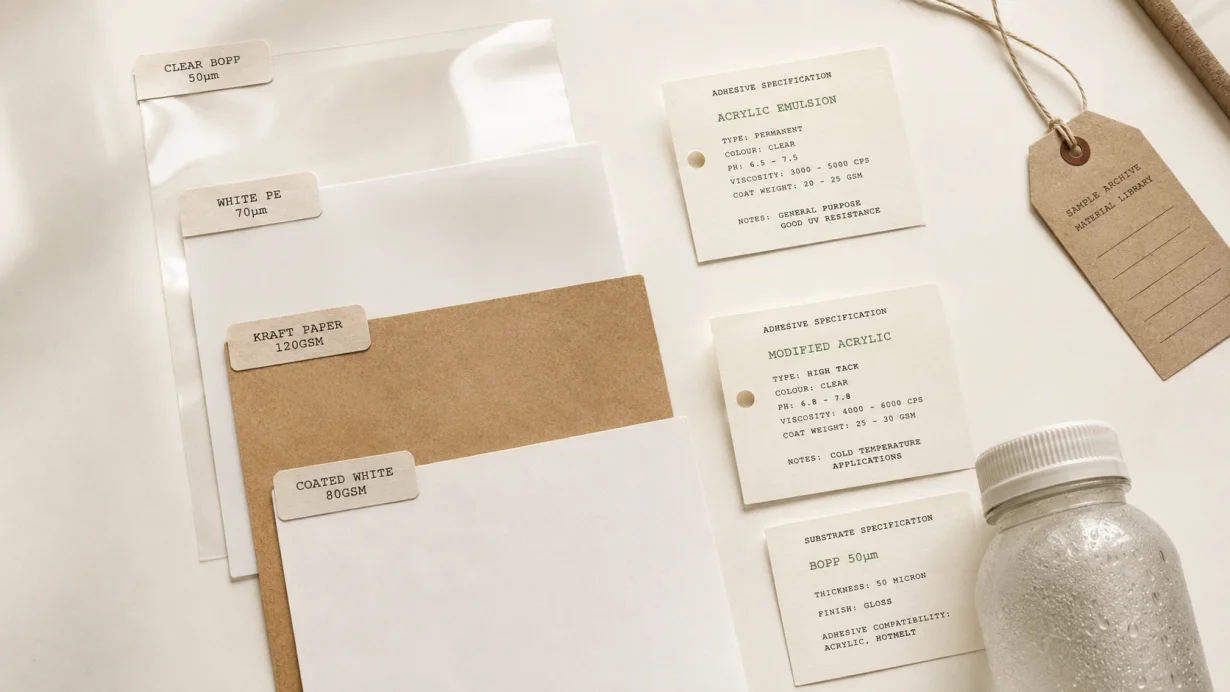
The Misstep: The label supplier quoted a freezer-rated acrylic emulsion adhesive on a standard BOPP face stock. The datasheet confirmed adhesion at minus 20 degrees Celsius storage. The brand approved the material based on the storage rating. Nobody asked what temperature the product surface would be at the moment of label application.
The Friction: The production line applied labels immediately after blast freezing. Product surface temperature at application was well below the adhesive’s minimum application rating. The adhesive did not wet out. Labels appeared to bond at the line because the label was pressed flat by the applicator, but the bond was mechanical, not adhesive.
The Outcome: First reports came from the retailer within two weeks. Labels lifting at corners in freezer cases. Some labels detached entirely during handling. The manufacturer paused the line, restocked with a cold-application adhesive from a different supplier and absorbed the cost of relabeling the initial production runs. The corrected adhesive cost more per thousand and had a longer lead time. The total cost of the mistake exceeded the per-thousand savings from the original quote by a wide margin.
Adhesive Types for Cold Chain
Three main adhesive families are used for cold chain labels. Each family has a different profile across the three temperatures. Selecting between them is a production decision, not a price decision. This is similar to the material and method selection covered in Digital vs Flexo Label Printing: When Should a Growing Brand Switch?.
COLD CHAIN ADHESIVE FAMILIES
| Adhesive Family | Apply Temp | Storage & Cycling | Typical Mistake |
|---|---|---|---|
| Acrylic Emulsion Standard cold storage |
Above 5°C | To -20°C, moderate cycling | Applied to a product that was already blast-frozen. Adhesive fails to wet out and never fully bonds. |
| Modified Acrylic Cold application |
To -10°C | To -30°C, good cycling | Specified for the low storage rating only. Cold-application capability paid for but not needed. |
| Rubber Hot-Melt Deep freeze |
Above 10°C | To -40°C, strong cycling | Applied to a lower-energy substrate without confirming compatibility. Bond pulls face stock apart on rework. |
The right adhesive is determined by where your production line applies the label, not only by where the product is stored. That question also affects how accurate your initial quote will be against the final invoice, since specialty cold-application adhesives usually carry different pricing structures than standard freezer grades.
Questions to Ask Your Supplier Before You Order
PRE-ORDER SUPPLIER CHECKLIST
☐ Confirm application temperature rating. Ask for the minimum temperature at which the adhesive is rated to bond, not only the temperature at which it will hold after bonded.
☐ Confirm freeze-thaw cycling data. Ask whether the adhesive has been tested through freeze-thaw cycles, and at how many cycles the bond strength drops.
☐ Confirm substrate compatibility at cold temperature. Ask whether the adhesive has been tested against the specific container surface (PET, HDPE, glass, board) at the application temperature.
☐ Confirm liner behavior at cold conditions. Ask whether the release liner performs correctly when the label web is fed through a cold environment.
☐ Request a written specification. Get the adhesive family, application temperature, storage temperature, freeze-thaw tolerance and tested substrates in one document. Not a verbal answer, not a marketing sheet.
Cold chain labels rarely fail because someone bought a cheap adhesive. They fail because nobody asked the right temperature question at the right time.
Adhesive selection, cold chain performance and substrate compatibility vary by manufacturer, formulation and application conditions. Confirm all specifications with your label supplier and adhesive manufacturer before finalizing production. This article describes patterns observed across cold chain label production and is not a substitute for supplier-specific technical data.
FAQ
What is the most common cause of cold chain label failure?
Incomplete bond formation at application, not adhesion loss at storage temperature. If the adhesive cannot wet out at the temperature the label is applied, the label never fully bonds. The failure appears later during transit or shelf handling, but the root cause happened at the applicator.
Is ‘freezer-rated’ the same as ‘cold-application’?
No. Freezer-rated describes the storage temperature the adhesive can hold. Cold-application describes the temperature at which the adhesive can form a bond. Most freezer-rated adhesives require room-temperature or slightly-chilled application. A separate product family handles cold-temperature application.
Can I use the same adhesive for refrigerated and frozen products?
Sometimes, but not by default. Refrigerated storage (typically 2 to 8 degrees Celsius) and frozen storage (typically minus 18 degrees Celsius or below) are different performance conditions. Some general-purpose cold-storage adhesives cover both. Others do not. Confirm the adhesive’s tested temperature range before assuming it covers your storage state.
What is freeze-thaw cycling and why does it matter?
Freeze-thaw cycling is repeated temperature movement across the freezing point of water. It happens during distribution: freezer warehouse to refrigerated truck to dock to retail freezer. Each cycle stresses the adhesive bond as the substrate expands and contracts. Adhesives rated only for stable low temperature can fail after a few cycles even if the coldest point is within specification.
My labels passed supplier testing but fail in real distribution. Why?
Supplier testing usually happens in controlled laboratory conditions: consistent temperature, no vibration, no freeze-thaw cycling, no substrate variation. Real distribution introduces all of these. Ask your supplier whether the adhesive was tested in cycling conditions and against your specific container surface, not only at a single stable cold temperature.
How much extra should I expect to pay for cold-application adhesive?
Cold-application and deep-freeze adhesives typically carry a per-thousand cost premium over standard freezer-rated adhesives. Minimum order quantities are often higher too. Selection is not a cost decision. It is a production reality decision. A cheaper adhesive that fails in the field costs far more than the price difference at order.