
What this covers
Why labels lift at the vertical edges on bottles and jars, how to tell a material problem from an adhesive problem, and what to change before the next print run.
Who this is for
Brand owners whose labels have lifted at the edges after application, and brand owners specifying labels for tapered jars, curved bottles or squeeze containers for the first time.
Core finding
Edge lifting on a curved or tapered container is usually the face stock pulling itself off, not the adhesive letting go. Four observations tell you which one you have.
Bottom line
A stronger adhesive under the same stiff stock buys time rather than removing the cause. The material and the die line are the changes that settle it.
This article does not contain affiliate links.
If you are wondering why labels peel off bottles at the edges, the adhesive is probably not what failed. A stiff face stock applied to a curved or tapered container keeps trying to return to the flat shape it was cut in, and during its first day or two on the container that pull can beat the adhesive before the bond has finished forming. The fix is normally a change of material rather than a stronger glue.
Stop asking for stronger glue
The instinct when a label lifts is to blame the glue, because glue is the part whose job is obviously to stick. It is the wrong place to look first.
Every label material carries a stiffness that comes from two things, what it is made of and how thick it is. Paper and thicker polypropylene films are stiff. Thin machine direction oriented polypropylene and polyethylene films are much less so. Once a stiff material is wrapped onto a curve it spends the rest of its life trying to unwrap.
So the adhesive is not losing a fight it was set up to win. It is holding a material that works against it from the moment of application, on a shape that makes the work harder.
What edge flagging actually is
Before you change anything, check that you are looking at the failure you think you are looking at.
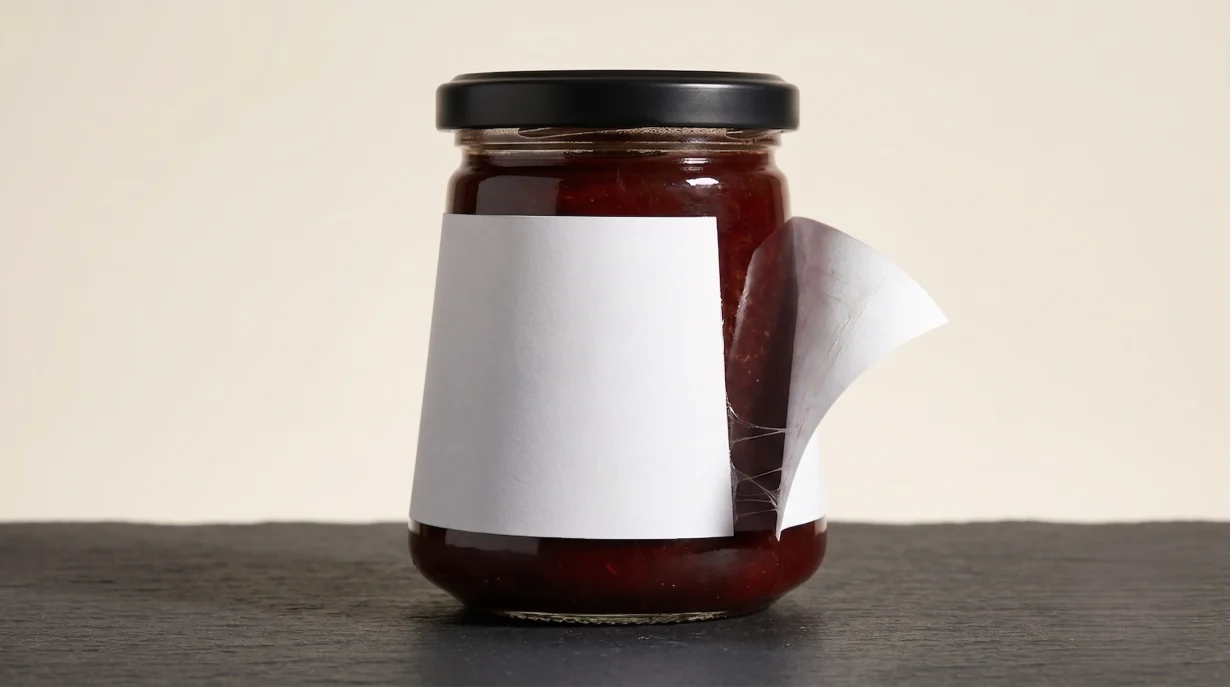
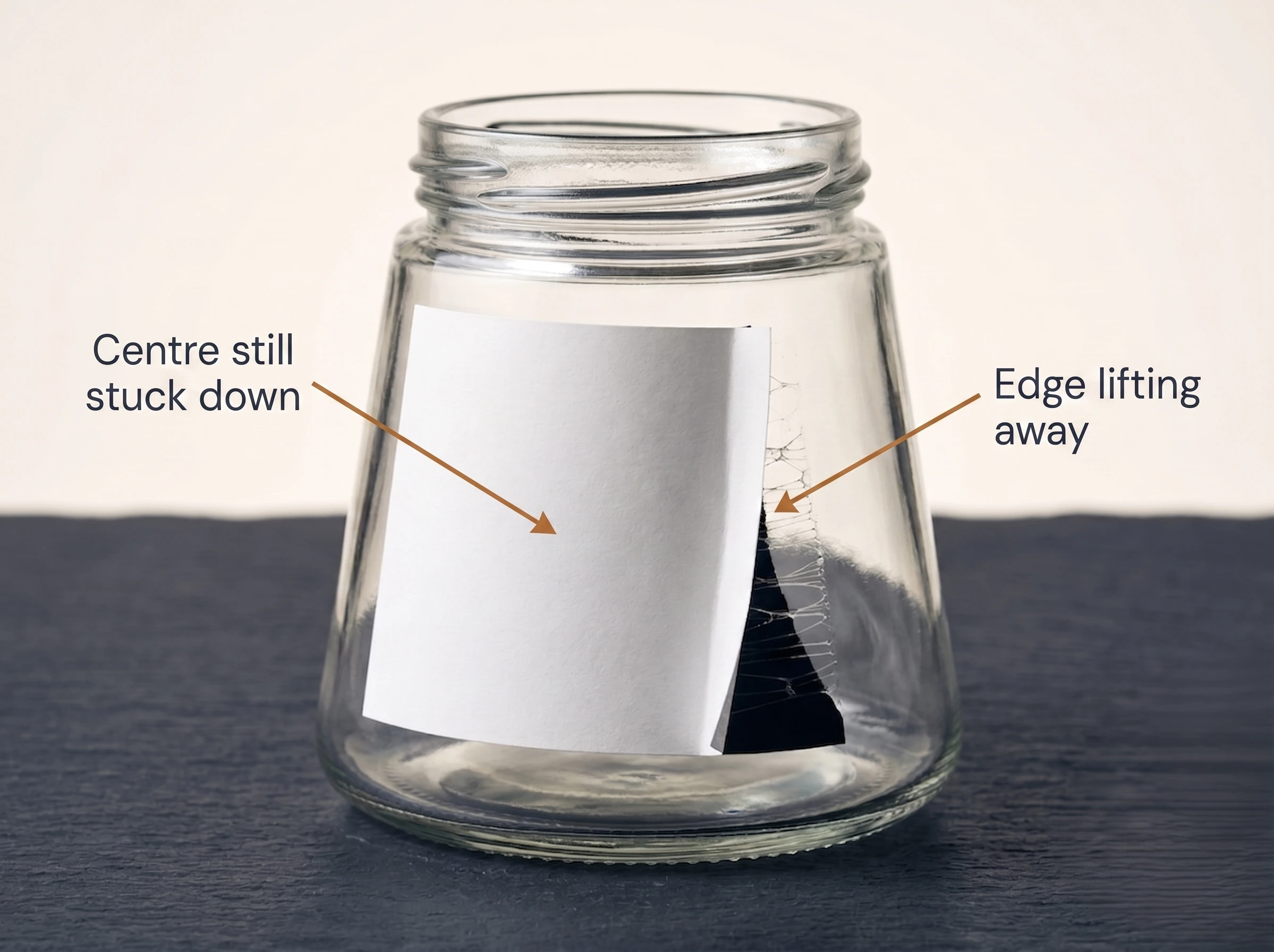
Edge flagging is the label lifting along one or both vertical edges while the centre stays down. In the trade you will also hear edge lift and tangential lift. When both edges come up and the middle holds, some printers call it butterfly lift.
It usually starts at a single corner rather than along a whole edge at once. Give it a few days and the lift travels inward from that corner, which is why a label that looked like it had one bad corner on Monday can be half detached by Friday. On automatically applied labels the trailing edge tends to go first, because that is the edge the applicator presses down last and with the least contact time.
It repays separating from the defects it resembles.
- Bubbling across the face points at how the label went on rather than what it is made of.
- Wrinkling or creasing points at a curve the label shape cannot follow.
- The whole label releasing cleanly points at surface energy or contamination.
- Curl before application points at the liner or at storage humidity in your own stockroom.
Getting the identification wrong costs a print run, because each of those has a different fix and printers price the fixes differently.
Why labels peel off bottles when the adhesive is fine
On a curve the label is being asked to hold a permanent bend against its own resistance. The tighter the diameter, the harder it pulls back, which is why the same stock that behaves on a wine bottle misbehaves on a 15ml sample vial.
On a taper, stiffness stops being the whole story and geometry takes over. A tapered panel is a slice of a cone. Wrap a rectangle around it and the top and bottom edges have to travel along different circumferences, which a flat shape cannot do. Something gives. Either the label wrinkles across the middle or the corners walk up, and a rectangular die line on a tapered jar is a defect with a date on it rather than a risk.
There is a version of this that catches brands out after everything was working. Adding a protective over-laminate for scuff resistance also adds thickness, and thickness adds stiffness. A label that sat flat on a curved container for a year can start lifting once lamination goes on top of it, and nothing about the adhesive changed.
Grain direction plays a smaller part in the same story. Paper stocks bend more willingly in one direction than the other, so how the label was laid out on the web can decide whether it wants to wrap or resist.
Why labels look perfect on the line and lift two days later
Pressure sensitive adhesive does not arrive at full strength. It gets there.
When a label is pressed down, the adhesive begins flowing into the microscopic texture of the container surface. FINAT FTM 1, the standard method for 180 degree peel adhesion, measures what the industry calls ultimate adhesion 24 hours after application, on a flat float glass plate.
That test tells you what the adhesive can do. It cannot tell you what the container will do to it. On a flat plate a stiff face stock exerts no pull, because there is no curve for it to fight. Wrap the same laminate onto a taper and that stiffness becomes a continuous load the test never applied.
Industry technical literature makes the same point from the other direction. A 180 degree peel result is really a measure of the substrate, the adhesive and the face stock working together rather than a measure of the adhesive alone, because the stiffness of the face stock is part of what the test records.
So the figures on a datasheet are real, and they were measured on the wrong shape. In our experience the lifting on tapered jars surfaces around two days after application, while the adhesive is still maturing and the face stock has been pulling since the moment it went on.
Once air is under an edge the adhesive there never wets out at all, so the lifted portion does not recover later even though the rest of the label reaches full strength on schedule.
On clear film labels you can sometimes see the difference. Adhesive that has wetted out looks optically clear against the container. Adhesive that has not looks slightly cloudy, and a cloudy band along an edge tells you the bond there never completed.
This is why the misdiagnosis is so common. Sign-off happens on the filling line while every label looks correct. The lifting turns up in the warehouse two days later, which reads as glue that stopped working rather than as a material that was never going to hold on that shape.
Cold chain labels fail through the same mechanism from the opposite direction. There the adhesive is too cold to wet out at all, so the bond never begins to form. Here the adhesive is wetting out normally and the face stock is simply stronger than the bond during the hours it takes to mature. Same process, different cause, and the fix in each case is a different one.
Production reality case
Food brands often specify standard paper for tapered jars, either for the craft look or to hold down first-run cost, and the same failure tends to follow. The labels go down flat on the filling line and pass quality sign-off. Two days later the client reports widespread edge lifting and assumes the adhesive is defective. The panel tapers, and the paper has been pulling against that geometry since the moment it was applied. Changing the specification to a conformable film with a curved die line cut to the container has settled it, and the reprints have not come back.
Four things to check before blaming the adhesive
You can diagnose most edge lift without instruments. Four observations narrow it, and all four are things you can see on a container already sitting in front of you.
Editorial framework, living standard
The Four-Check Diagnosis
1. What lifted. Edges up, centre down means material. Whole panel means something else.
2. When it lifted. On the line means application. Two days later means stiffness. In the customer’s hands means flexing.
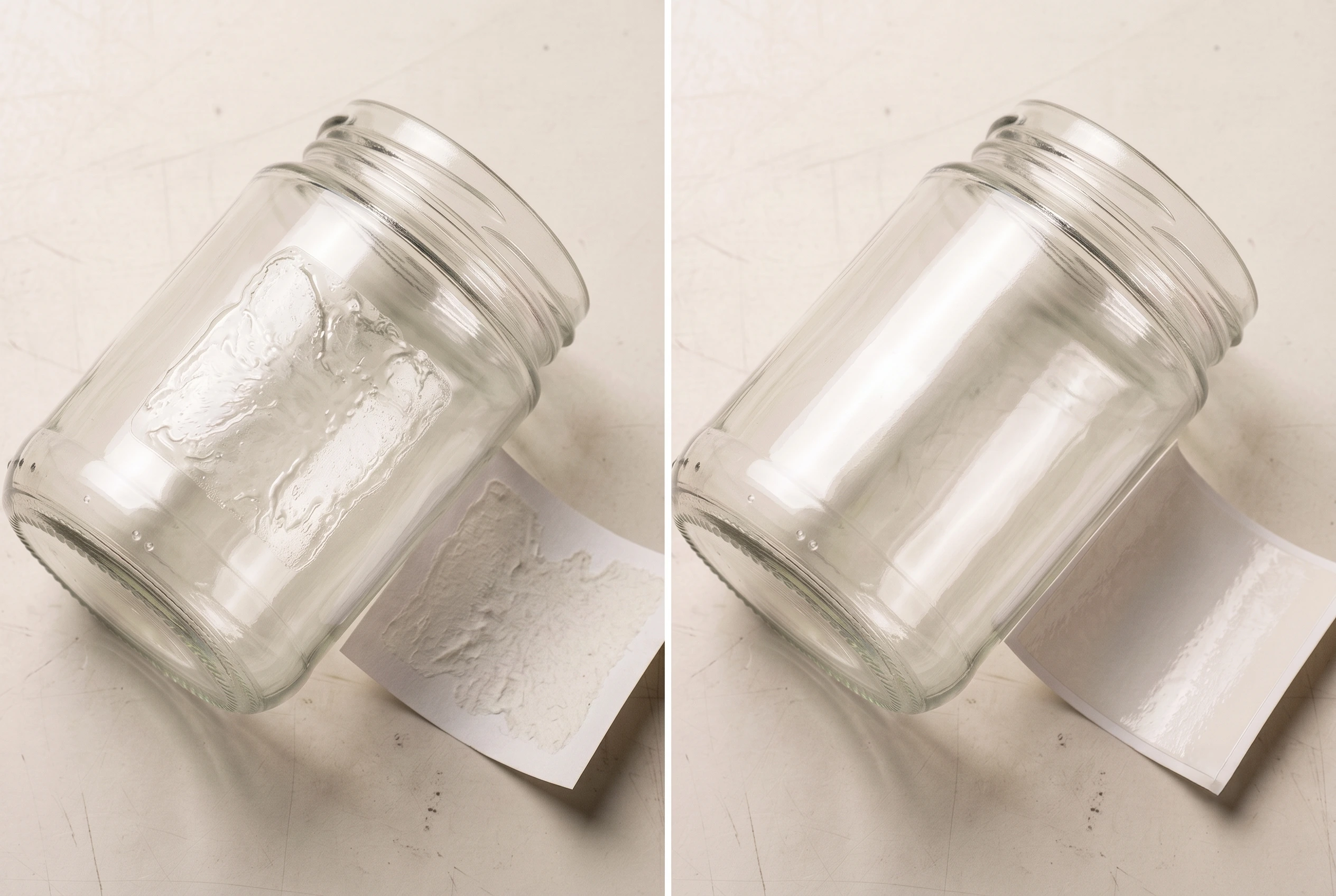
3. Where the adhesive ended up. Left on the container, the bond formed and failed. Still on the label, it never formed.
4. What the container does. Taper, squeeze, or tight diameter.
Read together, the four answers point at one cause rather than several.
| What you are looking at | What it usually points at | Where to go next |
|---|---|---|
| Edges up, centre down | Face stock stiffness against the container shape | Change the face stock |
| Wrinkle or crease | A curve the flat label shape cannot follow | Curved die line, or a shorter panel |
| Label off, adhesive on container | The bond formed, then failed under load | Squeeze deformation, adhesive choice |
| Label off, adhesive on label | The bond never formed | Contamination, surface energy, application temperature |
| Bubbles, edges holding | How the label was applied | Application method, not material |
The pattern to hold on to is check three. A label that failed leaves adhesive on the container. A label that never adhered comes away with the adhesive still on it. That single observation separates two problems with different owners.
Which containers cause it
Shape predicts most of it, and shape can be read without instruments.
| Container shape | What the label has to do | What usually needs to change |
|---|---|---|
| Straight cylinder | Bend one direction only | Usually nothing. Paper or BOPP tends to hold. |
| Small diameter | Bend tightly one direction | Thinner conformable stock. Ask what minimum diameter it is rated for. |
| Tapered or conical | Follow a shape a rectangle cannot match | Curved die line, plus a conformable film. |
| Squeeze container | Move with the container in use | Polyethylene film. Paper cracks along the fold and lifts. |
| Compound curve | Bend two directions at once | Smaller panel, or a film rated for that curve. |
The pattern across those rows is one thing repeated. The further a container departs from a straight cylinder, the less stiffness the face stock can afford to carry.
Container material sits underneath that as a second variable. A tapered glass jar and a tapered polyethylene tub present the same geometry and different surfaces, so the same face stock change can settle one and leave the other lifting.
When stronger adhesive actually helps
Sometimes the adhesive is the answer, and four situations point that way.
- Low surface energy containers. Polyethylene and polypropylene resist adhesion by nature, more than glass or PET do. A general purpose permanent adhesive can struggle on them however conformable the film above it is.
- Contamination. Mould release, silicone, dust or a fingerprint in the panel area keeps the adhesive from making contact at all. Containers that have sat open in a warehouse collect enough dust to matter.
- Cold or damp application. Adhesives carry a minimum application temperature. Applying below it, or onto condensation from a chiller, tends to produce a bond that looks correct and is not.
- Squeeze deformation. A container that flexes in the hand loads and unloads the bond every time somebody uses the product, so the failure appears with use rather than with time.
The distinction that matters is check three again. Adhesive left on the container after peeling means the bond formed and then gave way, which is a load problem an adhesive change can address. Adhesive still on the label means it never formed, which is a surface problem a stronger adhesive rarely rescues.
How to decide what to change
Work in this order, because the cheapest change usually sits at the top.
- Face stock. Move from paper or standard polypropylene toward a thinner conformable film. Machine direction oriented polypropylene for moderate curves. Polyethylene for containers that squeeze.
- Die line. On a tapered panel, ask for a curved die line cut to the container geometry rather than a rectangle.
- Panel size. Reducing label height reduces how much taper it has to absorb, and it is free.
- Adhesive. Only after the three above.
- Application. Clean, dry, and warmer than the adhesive’s minimum application temperature.
Each carries a cost worth knowing before you ask. Conformable films price above paper. A curved die line means a new cutting tool, so it is a one-time charge that lands harder on a small first run than on a repeat order. Reducing panel height costs nothing and is the change brands consider last.
The order matters because the conversation almost always starts at step four. Asking for stronger glue on the same stock is the most common response to edge lift and the least likely to settle it.
What to tell your supplier
A printer cannot specify around a container they have not seen. Container shape is one of the conditions that goes missing from a brief most often, alongside the others covered in Hidden Requirements.
Send your printer
- The container itself, or photographs from the front and the side beside a ruler.
- The intended label panel marked on the container or the photograph.
- What the container is made of.
- Whether the panel tapers, and whether the container gets squeezed in use.
- The temperature and humidity it sits at between filling and the shelf.
- Your four check answers, if you have run them.
The side view is the one that matters most and the one brands leave out. Taper is close to invisible from the front and obvious in profile.
There is a purchasing consequence here that is easy to miss. Two printers quoting the same brief at different prices are sometimes quoting two different specifications. A request for labels for a 250ml jar, with no mention that the panel tapers, gives a printer nothing to work from. One quotes the least expensive stock that holds on a cylinder, because that is what the brief described. Another recognises the shape and quotes a conformable film.
The second quote is higher and it is the correct one, and on paper it reads as the worse deal. The brand then does what anyone would do with two numbers and no explanation, and finds out which quote was right about eight weeks later. That gap is one of the things printers need resolved before they can quote accurately.
So the spread is not always a pricing difference. Sometimes it is a specification difference nobody wrote down, and the way to tell them apart is to ask each printer what stock they quoted and why.
What to do next
- Labels lifting on stock already printedRun the four checks on a failed unit before reordering, so the next run changes the right variable.
- Specifying a new labelPut container shape, material and use conditions in the brief before requesting quotes.
- A printer has offered a stronger adhesiveAsk what the face stock is first, and whether it changes.
- One printer quotes a conformable film and another does notAsk the second what happens on a tapered panel after two days.
Face stock behaviour, adhesive performance and container surface energy vary by material, supplier and application conditions. This article describes patterns observed across label production and is not a substitute for supplier-specific technical data.
Production economics, crossover points and material capabilities vary by supplier, equipment, order quantity and job specifications. Always consult with your packaging supplier before making final procurement decisions.
FAQ
Why do labels peel off bottles after 48 hours?
Pressure sensitive adhesive builds toward full strength over the first day or so, while a stiff label material pulls away from the moment it is applied. Where the material pulls harder than the early tack can hold, the edge separates before the bond matures. The delay is what makes it look like an adhesive failure.
How do I stop labels lifting at the edges on tapered jars?
Two changes tend to matter more than adhesive choice. Move to a thinner conformable film, and ask for a curved die line cut to the container rather than a rectangle. A flat rectangular label cannot sit flush on a tapered panel.
Is edge flagging caused by cheap adhesive?
Usually not. Edge lift with the centre still firmly down points at the stiffness of the face stock. A label that releases cleanly across the whole panel is the pattern that points toward the adhesive, the container surface or the application conditions.
What label material works best on squeeze bottles?
Conformable polyethylene film is the common answer, because it moves with a container that flexes in use. Paper and stiffer polypropylene films tend to crack along the fold line and lift from the edges. Confirm the specific grade with your supplier against your container material.
Do labels lift more on plastic than on glass?
Often, for two separate reasons. Plastic containers are more likely to be tapered, squeezed or moulded with release agents on the surface, and polyethylene and polypropylene have lower surface energy than glass, which makes adhesion harder to achieve in the first place.