

What This Covers
Why a sustainable label quote can double, or come out flat, told through two real quoting jobs. One where a compostable adhesive forced a full master roll purchase. One where a footprint redesign absorbed a material premium entirely.
Who This Is For
Brand owners who got a sustainable label quote back higher than expected and want to know what is actually driving the number before dropping the spec.
Core Finding
The facestock is rarely the reason a quote breaks a packaging budget. Adhesive minimums, order size and label footprint usually matter more than which fiber the label is made from.
Bottom Line
The same specification can price completely differently from one shop to another, so ask what is driving the number before assuming a sustainable material is out of reach.
This article does not contain affiliate links.
Sustainable label cost is sometimes higher than a standard run, and the reasons are rarely the ones a brand expects going in. A sustainable facestock does carry a premium in some cases, but the number that actually breaks a budget usually comes from somewhere else entirely: an adhesive that can only be bought by the roll, a label shape that wastes material on every impression, or a shop that has never run the material before and has to price around that risk. Two real jobs from our own shop show both directions. One where the sustainable spec doubled the quote for a reason that had nothing to do with the paper. One where a sustainable stock priced flat against a standard run, because the brand changed something else first.
Why the question gets asked wrong
Most comparisons stop at the roll. A brand gets a price on their usual semi-gloss paper, gets a second price on a recycled or compostable alternative, and treats the gap between those two numbers as the full cost of going sustainable.
It leaves out everything that happens after the material gets chosen. Setup, minimum order thresholds, how the label sits on the web, what finishing gets added, whether the shop already stocks the material or has to source it specifically for the job. A label quote is the sum of all of that, and the facestock is one line among several. Treating it as the whole story is where the frustration usually starts.
Where printers actually build the sustainable label cost
Facestock. The material itself, and the part everyone compares first. Its price varies by fiber source, by how common it is, and by how far a shop has to go to get it.
Adhesive. Rarely discussed at quoting stage and often the bigger swing. A sustainable adhesive is a different chemistry from standard permanent acrylic, and it does not always follow the facestock’s pricing logic. The same material-versus-adhesive question shows up when a label fails on the shelf instead of on the quote.
Finishing. Laminate, varnish, foil, embossing. None of these are sustainability decisions, but they get bundled into a “premium sustainable label” request often enough that they inflate a quote a brand attributes entirely to the material.
Minimum order quantity. The threshold below which a shop cannot run the job economically. This threshold moves depending on the material, and a specialty stock often forces a higher one than the shop’s usual paper, since a supplier unwilling to slit a low-demand material will sell it only by the full roll.
Freight and setup. Getting a material to the shop and getting the press ready to run it. Both scale worse on a small order than a large one, and both are indifferent to whether the material is sustainable.
Material pricing and supplier terms shift over time, so the two cases below are here for the mechanism behind each quote, not because the same numbers would apply today.
Production Case
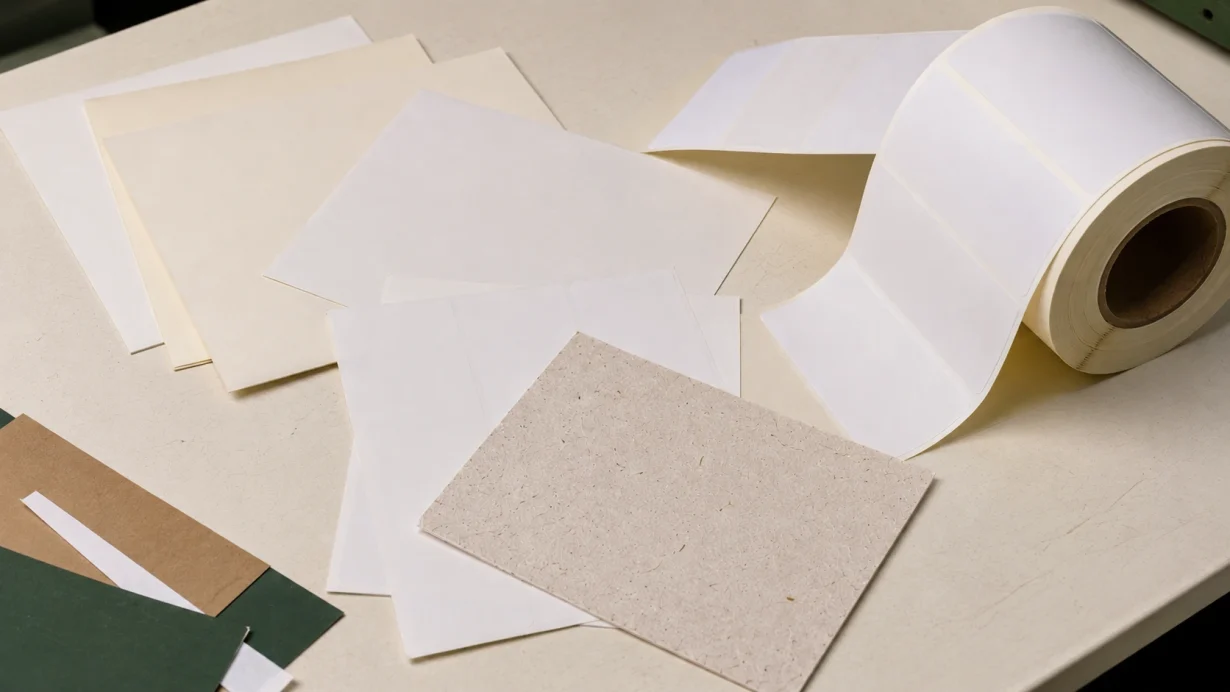
We quoted a job for a small-batch botanical skincare brand launching a line of face creams. They wanted a fully compostable self-adhesive label on an uncoated agricultural waste stock, and since our daily runners on the shop floor are standard matte, semi-gloss and glossy papers, we had to source the specialty construction specifically for their run. The brand expected a slight price increase for the natural paper, so when the first quote landed at more than double what they had budgeted for packaging, they assumed the paper was to blame.
It was only a minor factor. The real cost came from the glue and the minimum order quantity behind it.
Standard permanent acrylic adhesive, which we run every day, comes in narrow slits and short rolls without any trouble. The compostable adhesive this brand wanted was a specialty chemistry with far less market demand, and the material manufacturer would not sell us a narrow slit at all, only a full master roll. Their run was only ever going to use a small fraction of that roll. Compostable adhesive at the time carried a shorter shelf life than what we ran daily, and we understood it to be more sensitive to storage conditions, so we could not store the remaining eighty-five percent on a rack to use months later without real risk to the material. To protect our shop, the quote had to account for the entire roll.
Once we walked the brand through the mechanism behind the number, they adjusted their spec. They kept the natural textured facestock to hold their visual look on shelf, but dropped the compostable adhesive for a standard permanent acrylic instead. That single change brought the quote back into budget and let them launch on time.
This is what happens at a shop running standard daily stock and sourcing specialty material per job rather than keeping it shelved. A converter that specializes in compostable materials may already carry that adhesive in a usable width, with enough other clients running it that the shelf-life problem barely exists for them. This is one shop’s account of one job, not a rule that holds everywhere.
The moisture sensitivity in this case belonged to the specific adhesive we sourced for that run, not to compostable adhesive as a category. The chemistry is moving quickly, and a formulation available now may behave differently than one sourced a year or two out. Adhesive sensitivity to storage and environmental conditions is not unique to compostable stock either, as cold chain applications show in a different way.
Because shop capability varies this much, the same specification can price completely differently depending on who quotes it, the same pattern behind three printers quoting the identical job at wildly different prices. Getting a second or third quote before dropping a spec is worth the time it costs.
Building artwork and specs around what a shop actually stocks
None of what follows requires abandoning a sustainable material. It requires knowing which questions change the number.
Ask what the shop runs daily. A material that is somebody’s standard stock prices differently than the same material sourced as a one-off. Not every sustainable option is exotic to every shop.
Ask whether the minimum comes from the manufacturer or the shop. These are different constraints. A manufacturer’s minimum roll size is fixed. A shop’s purchasing policy is not, and a different shop may have already solved it by stocking the material themselves.
Ask what the adhesive is doing to the number. As shown above, it is often the larger swing, and it is the line item nobody asks about first.
When sustainable labels don’t cost more
Production Case
A client wanted to move their specialty food jars from a standard semi-gloss to a premium recycled cotton stock. The sustainable paper carried a heavy material premium, and if we ran the exact same label size on the new stock the quote was going to jump past their margin limits.
Instead of dropping the paper, they changed the footprint.
They abandoned their full wrap-around rectangle and redesigned the artwork to fit a smaller custom die-cut shape that only covered the front of the jar. Because the new design used far less square footage per unit we were able to step more labels across the width of the web and drastically cut the total material used.
By right-sizing the label footprint they absorbed the premium of the paper. The final quote for the sustainable cotton label came out completely flat against their old standard run.
The material never changed. What changed was how much of it the job actually consumed. A full wrap uses more paper per unit than a smaller front-facing die, and on a premium stock that difference is where the cost was hiding.
This is the case worth remembering before assuming a sustainable material has to cost more: the label’s footprint is often a bigger lever than the fiber choice underneath it.
What usually matters more than the material itself
Both cases point the same direction. Order size, footprint and adhesive tend to move a quote further than which fiber the facestock is made from, which is worth remembering before chasing the cheapest sustainable material while a wasteful die shape or an unnecessary laminate sits untouched.
Before assuming the sustainable quote is fixed, ask these in order
- What is actually driving this numberAsk the shop to separate the quote into material, adhesive, setup and finishing rather than accepting one total. The two cases above both resolved once this question got asked.
- Is the minimum the manufacturer’s rule or the shop’s own policyOne is fixed. The other might not be, and a different shop may already have solved it.
- Would a different footprint or die shape change the material usedNot the material itself, how much of it the job consumes.
- What would this shop’s daily stock look like on this jobA material that is somebody’s standard order prices differently than the same material sourced specially.
- Get a second quote on the identical specNot a cheaper sustainable label. The same one, from a shop that may already run this material every day.
In both cases, the quote only became understandable once the mechanism behind it was explained. That may be the most useful question a buyer can ask. Not why is this label so expensive, but what is actually driving this number.
A Note on This Article
Label & Bind writes from production experience rather than as a verification or legal service. This article describes patterns observed in our own quoting history. Production economics vary by supplier, equipment, order quantity and job specifications, and material pricing moves quickly enough that any figure printed here would be out of date within months. Always confirm current pricing and specifications with your own supplier.
Facestock behavior, ink absorption, adhesive performance and end-of-life outcomes vary by manufacturer, formulation, press conditions and regulatory regime. Confirm all specifications with your label supplier and adhesive manufacturer, and with legal counsel where marketing claims are involved, before finalizing production. This article describes patterns observed across label production and is not a substitute for supplier-specific technical data or regulatory advice.
FAQ
Why did my compostable label quote come back so much higher than expected?
The premium usually comes from the adhesive and the minimum order quantity rather than the facestock alone. A shop that already stocks the compostable adhesive you want may not face the same minimum-roll problem a general-purpose shop does.
Why would a printer require a full roll of material for a small order?
If the adhesive or facestock has low demand and the shop does not normally stock it, the material supplier may only sell it by the full roll rather than a narrow slit. Materials with a shorter shelf life compound this, since the shop cannot hold leftover stock for a future job.
Can changing the label’s shape reduce the cost of a sustainable material?
Yes, in some cases by a wide margin. A smaller footprint means less material consumed per unit, and on a premium stock that difference can offset some or all of the material premium.
Why did two printers quote the same sustainable label specification so differently?
Shop capability varies more than most buyers expect. A shop that regularly runs a given sustainable material has already absorbed the sourcing and minimum-order problem into its normal operations. A shop sourcing it for the first time has not, and prices accordingly.
Should I drop a sustainable spec if the first quote comes back high?
Not before asking what is driving the number. In both cases in this article, the spec that looked unaffordable at first quote either became affordable through a small change, or turned out to be priced fairly once the mechanism was understood.