

This article does not contain affiliate links.
WHAT THIS COVERS
What label suppliers actually need to know before they can produce an accurate quote, why most briefs leave critical information out, and how that information gap creates the price revisions, lead time changes and supplier frustration that small brands experience again and again.
WHO THIS IS FOR
Brand owners, operations managers and procurement leads requesting label quotes from suppliers, especially first-time or second-time label buyers who are not yet sure what information their supplier expects.
CORE FINDING
Most quote inaccuracy is not a supplier problem. It is an information problem. Suppliers cannot price a job they do not fully understand, and they default to standard assumptions whenever the brief leaves gaps.
BOTTOM LINE
The Quote Accuracy Gap is the distance between what the buyer provides and what the supplier needs to know. That gap is where most quote problems begin.
Most label quote problems do not start with the printer.
They start in the email that says: “Can you quote 50,000 labels?”
The brand sends artwork. The brand sends dimensions. The brand sends a quantity. The supplier opens the email, scans the request and starts building a quote with what is on the page in front of them. The quote gets sent back the same day. The brand sees a number. The number looks reasonable. The job moves forward.
Then reality enters the picture.
The labels are going on plastic, not glass. The cartons are headed into freezer storage. The application is automated, not manual. The launch date requires delivery weeks earlier than standard lead time.
The job stops. The quote changes. The timeline moves. The relationship becomes strained.
From the buyer’s perspective, the supplier changed the price.
From the supplier’s perspective, the original quote was built on incomplete information.
We wanted to help. We simply could not price the job properly because key information was missing.
The problem is not usually the supplier. The problem is the gap between the information provided and the information required to make production decisions.
That gap appears every day across the label industry.
The Quote Accuracy Gap is the distance between what the buyer provides and what the supplier needs to know. Most quote problems begin in that gap. The larger the gap, the more assumptions the supplier must make and the more likely the quote will change once production reality fills in the missing context.
Many buyers assume that dimensions, artwork and quantity are enough information for a label quote. In reality, label printers typically need details about the container, application method, storage conditions, volume expectations and finishing requirements before they can quote accurately. When that information is missing, suppliers fill the gaps with assumptions, and those assumptions often become the source of later price revisions, specification changes and production delays.
How Quotes Actually Get Built
When a quote request arrives, a supplier is not calculating a single number.
They are making a series of production decisions.
They need to determine which material fits the application. They need to select an adhesive that will perform under the expected conditions. They need to decide how the labels will be produced, finished, packed and delivered. They need to estimate setup costs, production time, material consumption, labor requirements and scheduling impact.
Every one of those decisions depends on information supplied by the buyer.
When the information is complete, the quote is usually accurate.
When the information is incomplete, the supplier has two choices.
They can stop and ask questions.
Or they can make assumptions.
In practice, most suppliers make assumptions because quote requests arrive constantly, buyers often need pricing quickly and many requests never become actual orders.
The challenge is that assumptions are based on typical jobs.
Your job may not be typical.
A quote built on standard assumptions may be completely accurate for one application and completely wrong for another. The supplier often does not discover the difference until additional information emerges later in the process.
That is where The Quote Accuracy Gap begins to create problems.
Some of the least accurate quotes suppliers send are also the fastest. Speed arrives before enough information exists to price the job properly. The buyer reads the quick response as service. The supplier reads it as the only option given the time available. Both are correct. Neither closes the gap.
The Quote Accuracy Gap Has Three Causes
The information missing from a typical label brief is not random. It falls into three predictable categories. Naming them helps explain why the gap exists, and where to close it.
Missing operational context. What the labels will actually face once they leave the supplier. Container type, application method, storage and lifecycle conditions. This is the information closest to the buyer’s daily business and most often assumed to be obvious.
Missing commercial context. How the labels will be ordered over time. Volume, reorder cadence and timeline. This is the information that determines whether plates are worth investing in, how the job is scheduled and which pricing tier applies.
Missing production context. What the supplier needs to produce the labels physically. Finish expectations, regulatory requirements and artwork status. This is the information that determines press configuration, prepress time and material certification.
Most briefs include parts of one or two of these categories. Almost no brief covers all three in full.
Buyers usually know all three categories. They simply do not realize suppliers need all three before pricing can become accurate.
The Eight Pieces Suppliers Actually Need
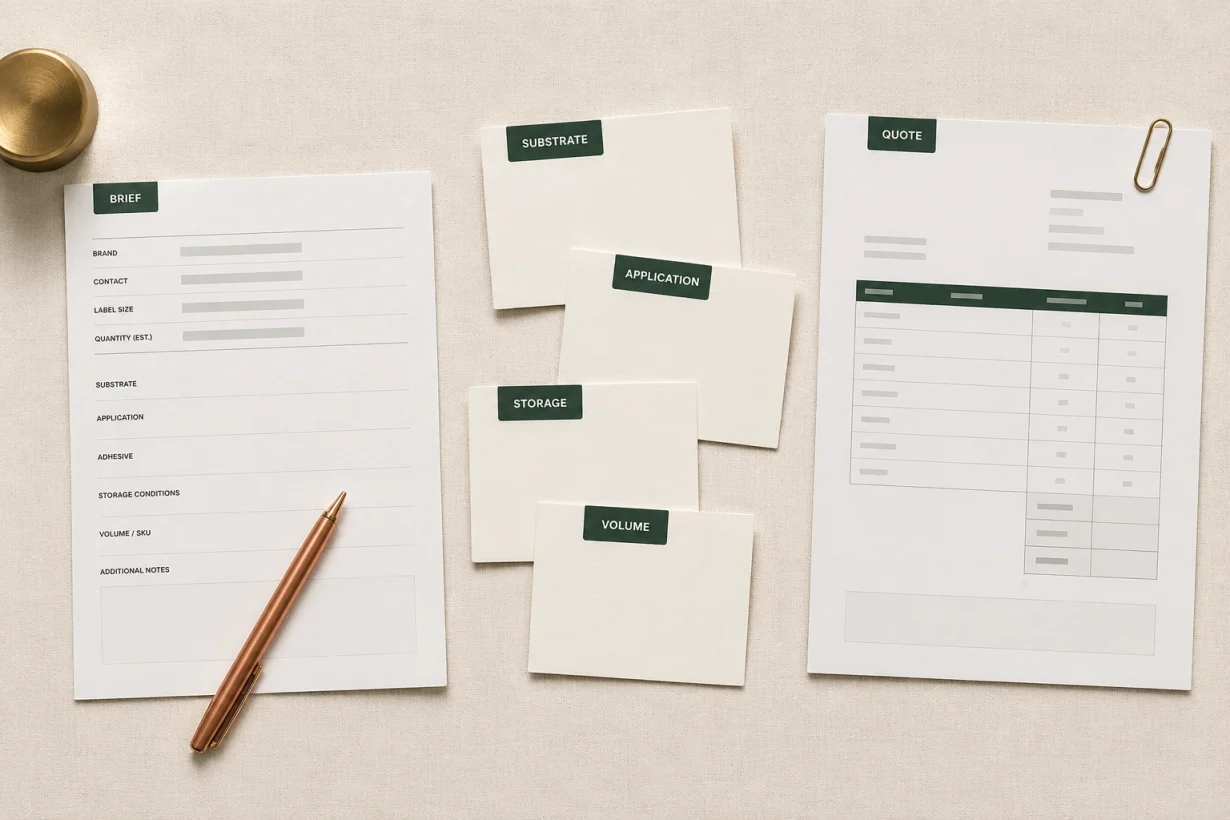
The three causes of The Quote Accuracy Gap break down into eight pieces of information. A brief that covers all eight produces an accurate first quote. A brief that leaves them out produces a number that changes later.
WHAT SUPPLIERS NEED TO QUOTE ACCURATELY
Missing operational context
☐ Container type and substrate: Glass, plastic resin, metal, paper, corrugated. Surface energy varies. Adhesive choice depends on it. “Plastic” alone is not enough. PET, HDPE, polypropylene and polyethylene each behave differently.
☐ Application method: Hand-applied, semi-automated or high-speed automated. Line speed if known. Surface curvature. Textured surfaces need different adhesives than smooth ones.
☐ Storage and lifecycle conditions: Freezer, refrigerated, ambient, outdoor, temperature cycling, UV exposure, moisture, abrasion. The conditions the label will face determine the material and adhesive specification.
Missing commercial context
☐ Volume and reorder cadence: Annual quantity, per-order quantity, reorder frequency. Affects whether plates are worth investing in, MOQ tiering, pricing breaks and material sourcing.
☐ Timeline and delivery expectations: Standard lead time, rush requirement, drop-ship specifications, palletization needs. Press scheduling depends on it.
Missing production context
☐ Quality and finish expectations: Glossy, matte, satin, foil stamping, embossing, spot UV, varnish. Each adds cost. Each changes the press configuration.
☐ Regulatory and compliance requirements: Food contact, child safety language, multilingual export, FDA, USDA, claim substantiation. Material certifications and label content depend on it.
☐ Artwork status: Print-ready files, dieline specifications, color separations, color management workflow, soft proof versus hard proof requirements. Prepress time and accuracy depend on it.
A brief that addresses all eight categories is a brief that produces an accurate quote. A brief that addresses three or four leaves the supplier filling in the rest.
What Happens When This Information Is Missing
When the brief is incomplete, the supplier defaults to the most common configuration. Standard adhesive. Standard liner. Standard material. Standard lead time. Standard rewind direction. The quote gets built on those assumptions, and the buyer receives a number that reflects the standard configuration, not their actual job.
Then production starts and the assumptions get tested against reality.
REAL PRODUCTION EXAMPLE
A specialty food brand requested a high-volume quote for jar labels. The request included artwork, dimensions and quantity. The quote was built using standard gloss paper with a general-purpose permanent adhesive. That was the baseline assumption for ambient jars.
Right before final proof approval, an offhand comment in an email revealed that the jars were flexible plastic deli containers destined for blast-freezer storage. The entire job had to halt and requote.
Standard paper would disintegrate from frost and condensation. General-purpose adhesive turns brittle and releases from plastic at sub-zero temperatures. The specification had to be rewritten for a moisture-resistant BOPP substrate paired with a freezer-grade adhesive.
The new quote landed well above the original. The timeline was blown. The brand was frustrated. The supplier was frustrated.
Nothing was wrong with the original communication except for the missing four words: plastic container, freezer storage.
This is what The Quote Accuracy Gap costs. Not just price revisions. Lead time pressure. Strained supplier relationships. Reprints. Inventory replacement. Retail delivery delays. The unit cost of the labels is rarely the painful number. The painful number is the rework cost layered on top.
A different version of the same gap shows up with automated application. A brand requests a quote for labels going on a curved cosmetic bottle and provides dimensions, artwork and quantity. The supplier prices the job assuming hand application, which is the most common configuration. Three weeks before launch the brand mentions the labels will run on a high-speed automated line. The original material has too much memory for the applicator and curls back off the bottle. The job halts. The substrate has to change. The cost changes with it. Same gap, different specification missing.
The brief that arrived was not technically incomplete from the buyer’s perspective. They thought they had provided what was needed. From the supplier’s perspective, the most important specification was missing entirely.
This pattern repeats across the industry. The conditions that matter to production are exactly the conditions that buyers forget to specify, because at the moment of the quote request, those conditions feel like context everyone in the business already knows. The supplier does not work in the business. The supplier knows what is in the email.
This is the same pattern covered from the buyer perspective in What a Label Supplier Brief Should Contain Before You Request a Quote. The framework on the buyer side mirrors what the supplier needs on the production side. And the operational consequences when this information is missing are exactly what becomes Why Labels Pass Approval and Still Fail in Production once the labels are produced and applied.
The most expensive label quote mistake is treating the first number as the real number. When the brief is incomplete, the first quote is a placeholder. The real quote arrives later, after reality fills in the assumptions the supplier had to make.
Why Suppliers Cannot Just Ask
In practice, suppliers do ask, but only for the most critical gaps and only when there is time. A small label printer working with thousands of brands cannot send a multi-question email back for every quote request. They quote dozens of jobs every week. Most of those quotes never become orders. The economics of running a quote desk require defaulting to standard assumptions and pricing fast.
Beyond economics, buyers often do not respond promptly to clarifying questions. Sales cycles are short. Buyers want a number, not a conversation. A supplier who replies with “we need more information before we can quote” is often replaced by a supplier who replies with a number based on assumptions.
The supplier is balancing two pressures. They want to quote accurately. They also want to win the job. Asking too many questions slows the response. Quoting too quickly produces inaccurate numbers. Most suppliers solve this by quoting fast with assumptions and adjusting later when the real specifications surface.
That trade-off is structural. It is not a flaw to fix on the supplier side. It is a reality to work with on the buyer side. The brief that closes the gap before quote request gets the most accurate number.
Two buyers can request the same label dimensions and quantity and need completely different materials, adhesives and production workflows. The supplier cannot see that from the brief alone. Only the buyer can.
How to Brief a Supplier So Quote Accuracy Improves
The fix is unglamorous: give the supplier the eight pieces of information they need before they have to ask. Most of this information is already known to the buyer. The buyer simply has not been told it is required at quote stage.
The supplier brief framework covered in What a Label Supplier Brief Should Contain Before You Request a Quote addresses this from the buyer side. What follows is the supplier-perspective version of the same workflow. The information categories that, if specified up front, eliminate most of The Quote Accuracy Gap.
THE QUOTE ACCURACY CHECKLIST: BEFORE REQUESTING A LABEL QUOTE
☐ Container: State the exact container type and material. Glass, polyethylene, polypropylene, PET, metal, corrugated. Not just “plastic.”
☐ Application: State whether application will be manual, semi-automated or high-speed automated. State line speed if known. State any unusual surface conditions (curved, textured, narrow).
☐ Conditions: State storage temperature range, refrigeration, freezer, outdoor exposure, UV, moisture, abrasion contact and lifecycle conditions.
☐ Volume: State annual quantity, per-order quantity and expected reorder cadence.
☐ Finish: State the finish expectations. Gloss, matte, satin, foil, embossing, spot UV, varnish.
☐ Regulatory: State whether the product requires food contact, claim substantiation, language requirements for export markets or any other regulatory criteria.
☐ Timeline: State the deadline, rush requirements, drop-ship specifications and palletization needs.
☐ Artwork: State whether print-ready files are available, dieline specification status and color management requirements.
Eight categories. Most fit in a single page or a structured email. The brief that includes them all gets the most accurate first quote. The brief that leaves them out gets a number that will change later.
Related Reading
For deeper coverage of the procurement decisions adjacent to The Quote Accuracy Gap:
- What a Label Supplier Brief Should Contain Before You Request a Quote — the buyer-side framework for building a complete brief
- How Label Printers Quote the Same Job at 3x the Price — how the same job lands at radically different prices, driven by the same information gap
- Why Labels Pass Approval and Still Fail in Production — what happens to incomplete briefs once the labels are produced and applied
- Label Printing Cost: Why Your Quantity Doesn’t Tell You What You’ll Pay — what the supplier is actually pricing once the brief arrives
For industry standards behind quote accuracy and material specification, FINAT’s published technical guidelines cover label industry standards including substrate compatibility and adhesive performance test methods that suppliers use when matching material to application.
Production economics, material capabilities and adhesive performance vary by supplier, substrate, environmental conditions and application equipment. Always consult with your packaging supplier before making final material decisions.
Why do label printers ask for so much information before quoting?
Because each piece of information determines a specific production decision. Material choice, adhesive selection, press configuration, finish, lead time and pricing all depend on the application conditions, volume and quality expectations. A supplier quoting without this information has to make assumptions, and the assumptions create the price revisions later.
What is the minimum information a label printer needs to quote accurately?
At minimum: container type and substrate, application method, storage and lifecycle conditions, volume, finish expectations, regulatory requirements, timeline and artwork status. Eight categories. Most briefs include three or four of these. The remaining gap is where quote inaccuracy begins.
Why does my label quote keep changing after I receive the first estimate?
Because the first estimate is built on the information the supplier received, plus assumptions about the information they did not receive. As real specifications emerge (the actual container, the storage temperature, the application method), the assumptions get replaced and the price adjusts. The first quote is a placeholder. The accurate quote arrives once the brief is complete.
Whose responsibility is it to make sure a label quote is accurate?
It is shared between buyer and supplier, but the buyer has more control. The buyer knows their own operational context. The supplier only knows what is in the brief. Suppliers can ask clarifying questions, but they will not catch every gap. Prevention sits with the buyer providing complete information up front.
What is The Quote Accuracy Gap?
The Quote Accuracy Gap is the difference between what the buyer provides in a label quote request and what the supplier needs to know to produce an accurate price. It has three causes: missing operational context, missing commercial context and missing production context. Most label quote problems originate in this gap.