

This article does not contain affiliate links.
What this covers
The 7 invisible variables that cause wild price variance in label printing quotes.
Who this is for
Founders and operations managers comparing custom label pricing.
Core finding
A label quote is not a price. It is a calculation based on assumptions. When suppliers guess differently about your substrate, tooling, or printing process, the prices diverge.
Bottom line
The cheapest quote is often the quote with the lowest-quality assumptions. Reading the specifications, not just the final dollar amount, is what catches the gap.
Here is a label printing cost scenario almost every founder and operations manager eventually faces.
You send the exact same brief, for the exact same label, to three different commercial label printers. A few days later, the quotes hit your inbox. Supplier A quotes $800. Supplier B quotes $1,400. Supplier C quotes $2,400.
Your immediate instinct is to assume Supplier C is gouging you, Supplier B is the safe middle ground, and Supplier A is giving you a great deal. In the commercial printing industry, a 3x price variance on the exact same request rarely means one supplier is fundamentally cheaper than another. It usually means the suppliers are not actually quoting the same job.
Label suppliers are not quoting the same job. They are quoting what they understood from your request. The 3x variance lives in the brief, not the supplier.
Why the same job comes back at three different prices
When a label printing cost comes back drastically lower or higher than a competitor’s, it is because of an information gap.
If your initial request lacks rigid, technical specificity, if you ask for “10,000 glossy labels for cold brew coffee,” you have forced the estimating department to make educated guesses.
One estimator might assume you want standard paper with a glossy varnish. Another might know that cold brew creates heavy condensation, so they quote a moisture-resistant polypropylene (BOPP) film with a waterproof laminate.
Both estimators are trying to solve your problem, but they are using completely different materials and machinery to do it. The result is a massive gap in label printer pricing. Reading the quote correctly means looking past the bottom-line dollar amount and into the mechanics of the calculation itself.
Why a quote is not a price
A commercial label quote is often read as a fixed price tag for a finished product. It is not.
A quote is a mathematical calculation based on a specific set of production assumptions. When a founder submits a brief that leaves room for interpretation, the estimating department fills in the blanks based on their equipment, their typical customer profile, or what they believe will win the bid. If Supplier A assumes a simple paper construction and Supplier B assumes a heavy-duty film construction, their outputs will look drastically different. They are no longer pricing the same physical object.
The implication is simple. Comparing two quotes that look like they price the same job is often comparing two quotes that price different jobs.
What founders expect
- The supplier calculates the cost of ink and paper.
- The supplier adds a standard profit margin.
- The quote reflects the true market value of the label.
What quotes actually contain
- Assumptions about the exact substrate, standard semi-gloss paper versus moisture-resistant BOPP.
- Assumptions about the machinery used, digital versus flexographic.
- Assumptions about finishing methods and tooling requirements.
The 7 variables that drive quote variance
Not all variables impact the final number equally. When comparing quotes with substantial pricing gaps, the variance is usually driven by four major factors: substrate selection, print process, finishing and quantity breaks. Secondary drivers like tooling charges, roll configuration and scheduling can shift the margins, but they rarely double or triple the total cost on their own.
Here is how estimators translate typical requests into the variables that dictate your final cost.
3.1 Substrate and adhesive assumptions (major driver)
What founders typically request: “We need high-quality labels for our sauce jars.”
What suppliers actually assume: Without environmental specifications, suppliers often default to what they run most efficiently. One might quote a standard semi-gloss or glossy paper with a general-purpose adhesive to keep the cost low. Another, noting the word “sauce,” might assume the jar will be refrigerated and quote a white BOPP (polypropylene) film with an aggressive cold-temp adhesive so the label survives condensation.
Why it affects the quote: Films like BOPP or vinyl are inherently more expensive than standard matte or glossy papers. An estimator protecting your brand’s integrity with a durable film will almost always return a higher quote than an estimator just trying to win the job with cheap paper.
3.2 Print process selection (major driver)
What founders typically request: “Quote for 10,000 custom labels.”
What suppliers actually assume: The supplier routes the job to the press that makes the most sense for their current floor capacity.
Why it affects the quote: Digital presses require no physical plates and have minimal setup time, which makes them cost-effective for short and medium runs. Traditional flexographic presses require custom printing plates and significant setup time, plus material waste, before the first good label comes out. If one supplier routes your 10,000-unit run to a digital press and another routes it to a flexo press, the setup costs alone can create a large divide in the bottom line.
3.3 Finishing assumptions (major driver)
What founders typically request: “Make it look premium.”
What suppliers actually assume: “Premium” is subjective. To one printer it means a simple liquid UV varnish applied inline. To another it means a heavy matte laminate. To a third it implies hot foil stamping.
Why it affects the quote: A standard varnish is relatively inexpensive. Laminates add another layer of physical material to the cost calculation. Embellishments like foil stamping or embossing require separate specialized tooling and slower press speeds, which adds real cost to the quote.
3.4 Quantity tier breaks (major driver)
What founders typically request: Pricing for a specific, current need such as 5,000 labels.
What suppliers actually assume: Estimators often quote the requested quantity but also provide pricing for the next tier up (for example, 10,000 labels) to show how the per-unit cost drops.
Why it affects the quote: Label printing is heavily front-loaded with setup costs. Once the press is running, the cost of printing label number 5,001 is fractions of a cent. If a founder compares a 5,000-unit quote against another supplier’s 10,000-unit volume-discounted quote without checking the quantities, the pricing will appear entirely disconnected. Those same setup costs set the supplier’s floor, which is covered in when a label MOQ is too high for your brand. They are also why quantity alone does not tell you what you will pay.
3.5 Tooling and die charges (secondary driver)
What founders typically request: A highly specific custom shape, for example 2.125″ x 4.875″.
What suppliers actually assume: Depending on the production method, custom shapes may introduce tooling costs. A traditional flexographic printer will quote a $150 to $300 custom rotary die charge. Another supplier might silently adjust your request to a stock 2″ x 5″ die to strip that charge and win the bid. A digital printer using laser or in-line digital die-cutting often skips this cost entirely.
Why it affects the quote: It creates a few hundred dollars of variance. On a $10,000 order, this is small. On an $800 short run, a tooling charge can shift the percentage gap noticeably.
3.6 Roll configuration and core size (secondary driver)
What founders typically request: “Labels on rolls.”
What suppliers actually assume: If you do not specify how the labels will be applied, the printer assumes standard hand-application specs, often a 3-inch core with a standard outer diameter.
Why it affects the quote: If the labels are running through an auto-applicator that requires an 8-inch outer diameter and a specific unwind direction, the supplier has to factor in extra rewind and splicing time. It is a smaller cost driver than substrate or quantity, but it shows up at the final invoice stage.
3.7 Production scheduling (secondary driver)
What founders typically request: “We need these as soon as possible.”
What suppliers actually assume: “As soon as possible” is not a timeline. One estimator assumes standard 10-day lead times. Another reads it as “needed by Friday” and bakes a rush-production premium into the quote.
Why it affects the quote: Rush production carries real cost in many shops. Some suppliers add a percentage premium, others quote based on whichever press slot is open. A vague timeline often defaults to the higher-cost assumption.
Real production example
The example below is simplified for educational purposes. Actual label pricing varies by supplier capabilities, materials, order quantities, production methods and application requirements.
Real production example
The scenario: A founder requests 20,000 labels for a new cold-pressed juice line. The brief includes the artwork, the dimensions and the quantity, but leaves the material unspecified.
The quotes: Supplier A returns $900. Supplier B returns $2,300.
The reality: The founder initially believes Supplier B is wildly overcharging. But checking the itemized specifications reveals the truth. Supplier A quoted standard semi-gloss paper with a general-purpose adhesive to be the lowest bidder. Supplier B noticed the product was cold-pressed juice, recognized the labels would face heavy refrigeration and condensation, and quoted a moisture-resistant BOPP film with a cold-temp adhesive. If the founder had chosen Supplier A based on price alone, the paper labels would likely have failed in grocery store refrigerators. Supplier B was not overcharging. They were the only one quoting a label built to survive the actual application environment.
How to read a quote that comes back high
When a quote comes back much higher than expected, the first step is not to negotiate. The first step is to decode the assumptions.
Place the high quote and the low quote side by side and look strictly at the line items. The variables from Section 3 are where the gap usually lives.
- Check the material specification: Is the cheap quote using paper while the high quote is using film?
- Check the press type: Did one quote specify “digital” while the other itemized “plates” and “setup”?
- Check the finishes: Is there a line item for a matte laminate on one, and a standard liquid varnish on the other?
If the specifications are not visible in the quote document, the supplier has not provided a transparent quote. For a complete guide on how to dictate these terms upfront, read the Label & Bind breakdown on what a label supplier brief should contain before you request a quote.
The most expensive mistake
The most expensive mistake in packaging procurement is buying on price without verifying the assumptions.
If you choose a low quote over a higher one simply because it is cheaper, but the cheaper labels peel off your product during transit, the true cost is not the original quote. The true cost is the wasted print run, the cost of the emergency reprint, the labor to peel and relabel the product and the reputational damage with retail partners.
Checklist: how to request comparable quotes
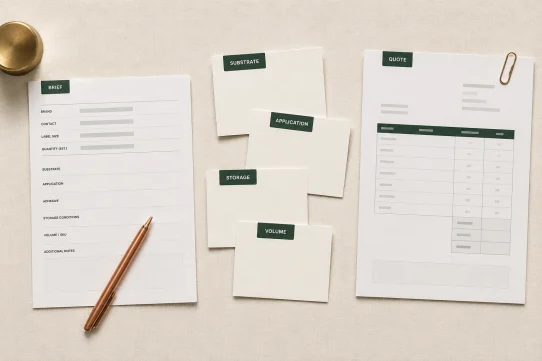
Stopping wild pricing variance means locking down the variables before the estimators can guess. The checklist below builds a brief that forces every printer to quote the same job.
Production checklist
☐ Exact substrate: Name the specific material (white BOPP, semi-gloss paper) or explicitly state the environmental conditions (must withstand freezer environments).
☐ Adhesive type: Specify whether the adhesive needs to be permanent, removable or cold-temperature.
☐ Application method: State clearly whether the labels will be applied by hand or by machine.
☐ Roll specifications: If machine-applied, dictate the core size (usually 3-inch), maximum outer diameter and unwind direction.
☐ Dimensions and tooling: Provide exact dimensions and state whether you are willing to adjust slightly to fit stock dies to save the tooling charge.
☐ Finishing: Specify the exact finish (gloss laminate, matte varnish, foil stamping).
☐ Quantities: Request pricing for the target quantity plus the next two volume tiers up (5,000, 10,000, 25,000).
☐ Turnaround time: State the exact date the labels need to be on your dock.
Substrate selection is where quote variance compounds the fastest. FLEXcon’s overview of pressure-sensitive film options walks through how polypropylene, polyester and polyethylene differ in real-world applications, which is the level of detail that separates a complete brief from an incomplete one.
FAQ
Why is label printing so expensive for short runs?
Traditional label printing is heavily front-loaded with setup costs. Making printing plates, loading the press and calibrating the colors takes time and wastes material. On a short run, those fixed setup costs make up the majority of the bill, which is why per-unit pricing drops dramatically at higher volumes.
Can I avoid tooling charges for custom label shapes?
In many cases, yes. If a supplier uses a traditional rotary die press, custom shapes carry a tooling charge for the new die. However, if the supplier uses digital printing with laser finishing or in-line digital die-cutting, they can cut custom shapes without charging for physical tooling. Asking suppliers which production method they use is often enough to surface the difference.
Does the number of colors affect the label quote?
It depends on the printing process. With flexographic printing, each color requires a separate physical printing plate, which adds cost. With digital printing, CMYK presses print full color in a single pass without plates, so the number of colors does not change the price. This is one reason short-run digital often comes back cheaper than flexo on multi-color jobs.
Should I just ask the supplier to quote their closest stock size?
If the packaging design has flexibility, asking the printer to use a stock die close to the requested dimensions (for example, accepting 2″ x 5″ instead of 2.125″ x 4.875″) is an effective way to eliminate custom tooling charges. The savings are most noticeable on short runs where the tooling charge is a larger percentage of the total order value.
How do I compare two completely different label quotes?
Trying to mentally adjust the prices does not work. The cleaner approach is to identify the discrepancies first (for example, one quoted paper, one quoted film), then go back to the cheaper supplier and ask them to re-quote using the exact same premium materials the higher quote used. Quotes only become meaningfully comparable when the line items match.